Showing posts with label chinese. Show all posts

Gyoza Senmonten Genbu (Gyoza/Noodles), Shimokitazawa

Chinese dumpling "Gyoza"s are often side dishes in Japan. People order them in Chinese joint as part of a bigger menu, paired with Ramen noodles or Chahan (Fried rice) for example, and rarely as a solo item. The trend has recently changed though, and restaurants specialized in Gyozas have lately increased. Gyoza Senmonten Genbu (Specialized Gyoza restaurant "Genbu") which opened in the summer of 2007 is one of them, and though seemingly going through high and lows in terms of occupancy, has established itself as a moderate player within the Shimokitazawa food business.

If you're wondering what Japanese-style fried Gyoza are, please click this wiki article on the dish. Should you want to skip on it, you just need to know that it's ground meat (most of the time pork) mixed with finely chopped vegetables (generally garlic, chinese cabbage and Nira garlic chives) wrapped and sealed in thin dough before being fried. I have also talked a little bit about the history of the dumpling in Japan and the not-so famous reason why Japanese added garlic in the Chinese recipe, in this post.

Genbu doesn't really look like a normal "Chinese" restaurants: most of the apparent infrastructures are in metal (even the stools are what seem like kegs with a cushion on top) and a big tv monitor near the kitchen plays MTVish R&B music, therefore giving the place a rather cluby look, uncommon in this neighborhood. However, don't let that modern western feel deceive you on the food quality: they do serve very decent dumplings and (less memorable) noodles.

I went for the house-speciality "TonToro Gyoza", which adds some gourmet pork cheek meat in its regular pate. The cheek is supposed to be one of the most tender part in the animal and butchers can only get a little amount from each pig so it is a "limited" menu, slightly more expensive than the more standard dumplings they also offer.

The gyozas were very well fried, the dough being nicely crunchy (but not hard) and golden-brown on one side whereas the other "rawer" faces offered more doughy resistance. Some bad places will sometimes offer you fried dumplings that have the same texture all around and that can be such a turn-off... The ground meat felt very tender indeed and the first bite freed a bit of some nice juice from the sealed dumpling. The amount of garlic felt just fine and balanced and the overall taste pleasant. The shop takes pride in recommending you to eat its Gyoza with lemon juice, salt and paper, and not with the orthodox soy-sauce/vinegar/chili oil mix, so you can enjoy the taste of the meat better. I can definitely recommend you to follow their advice. Good stuff.

A plate of Gyoza not being enough to fill my belly, I also ordered a Nira Ramen (Ramen topped with chopped Nira garlic chives), a dish that I have learned to appreciate at the excellent Chinese restaurant "Fuumin" in Omotesando. The waiter warned me that it is a hot and spicy noodle dish, but I ignored his tip and still went with it as the one I was used to in Fuumin is a delicate one based on a low-salt bouillon.
Well, stupid me: it was hot! Not the unbearable hot, but still enough to cleanse your system the next day...If you don't like hot, don't even think about trying this. The soup was so red-hot with Rayu (Chinese style chili-infused vegetable oil) and thus so chili spicy that I couldn't really tell what the broth was based on. There was a moderate topping of what I thought to be a mix of pork ground meat with a sesame oil based sauce, that smoothed the taste when mixed with the soup, but it still was not enough to clear the hotness.
The noodles used were interesting as they had the very characteristically firm texture, almost the color, the size and the taste (not too sure about the taste as it was lost in the chili aroma) of the noodles used in the Korean-style cold Reimen noodles. It is rather rare to have these used in hot noodles recipe so that's worth the experience.

At ¥500 the beer, ¥450 the Gyoza and ¥750 the noodle dish, this simple dinner amounted to ¥1,700, which is affordable. Their beer is nice and cool, so if you feel like munching on heaps of Gyozas while downing some draught beer, Genbu is definitely an affordable option. The waiters are polite and very professional.

By the way, it's next door to the uber-famous old-school Chinese eatery "Mintei".
And if you're into J-Pop, it's worth noting that the restaurant is owned by someone very close to the multi-platinum selling duo "Kobukuro". Who knows, they might come one day for a plate of Gyoza?

Genbu is open everyday from 11:30am to 04:00am
03-3481-5655
Setagaya-ku, Kitazawa 2-8-8
Click here for a MAP

Mintei (Chinese), Shimokitazawa

"Mintei", the epitome of a cheap eatery in rocking Shimokitazawa, is one of the, if not the most famous joint in the neighborhood. It is not the oldest establishment (if you're looking for an old one, check out the Japanese-Chinese "Rairaiken"), but it has been open for more than 40 years, which is quite old for Japanese standards.

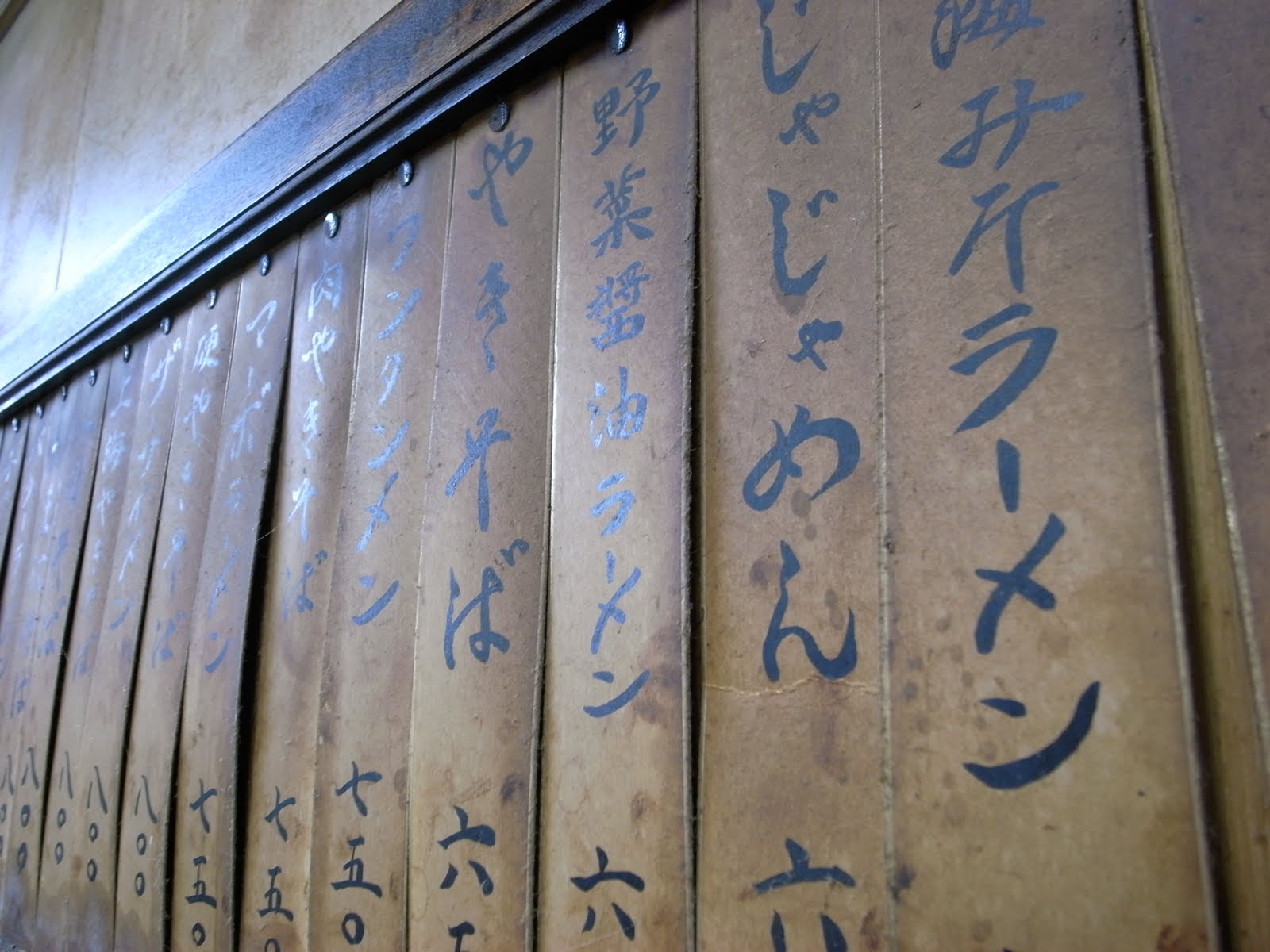
the worn-down old menu plates on the wall

I first went to "Mintei" when I was a teenager, which is a LONG time ago, and the place has not changed at all since. The only thing that has changed is probably the color of the several celebrity autographs on the walls, that have yellowed over the decades. One autograph that is worth mentioning is the one on top of the counter by the entrance, signed in 1989 by the vocalist from legendary punk rock band "The Blue Hearts", Hiroto Komoto.
Shimokitazawa being the THE indie/rock town of Japan, a lot of kids aspiring to be future stars, work part-time in some of the restaurants in the area before or after rehearsing at studios. Hiroto Komoto, one of them, used to work in Mintei in the 80s. The tradition is still holding strong, and if you ever visit this joint, you will probably see musician-looking-kids in the kitchen.
The customers are a mix of young couples, students, musicians, and middle-aged people from the neighborhood looking for a cheap meal.

the old autographs above the counter

Another thing worth noting is the rather "punk" catch-phrase outside the restaurant amusingly citing the joint as "serving the 3rd best food in the world". The reason why it's not the best or second best is, according to Mintei, because:
1. the best food in the world is the "Ofukuro No Aji", that is your mum's cooking (check out 2nd paragraph of this post for a little explanation)
2. the second best is your dad's shin taste when you bite on it (a Japanese expression saying "bite on your parent's shin" means to sponge off one's parents)
3, the third best food in the world is their Ramen

As you can see, one thing they do not lack is a good sense of humor. Now, is the food as good as the humor?

Well, I'd have to say it's not as great as what the joint's reputation would make you believe. I have never tried anything other than the "Edokko Ramen" (Edokko, literally kid from Edo, relates to a person born in Edo, the old Tokyo; such person is often perceived as being cheerful, in your face and straightforward), which consists of a big bowl of Shoyu Ramen with homemade Kimchi (Korean-style fermented cabbage with chili) on top and the "Wantan Men" (ramen with Chinese dumplings Won Ton), making it difficult to give you a constructive review of the place, but the house specialty "Edokko Ramen" is rather mediocre.

Edokko Ramen

The soup tastes like a lightly salted Torigara (chicken bones) and shoyu-based broth. It is relatively clear and not too oily. The soup tastes actually much better than the rest of the ingredients: the boiled Aona greens are very plain in taste and a bit too flabby, the large pieces of Chashu (Chinese style bbq pork) are fibrous and too low in salt.
The Kimchi is a little too strong in garlic for me, when I would have loved it slightly more sour and chilihot. It seems by the way quite unusual to name a Ramen "Edokko" when its particularity is the topped Korean item.
Last but not the least: the noodles, though ok in taste, are way lacking in Koshi, or firmness. I usually don't put much emphasis on the Koshi, but when the rest is average, you want at least your noodles to have some sort of character.

The Wantan Men's broth is on the other hand quite salty (even too salty I think), so only order it if you're ready for it.

As you can see, I'm not a big fan of their food. Once again, I've only tried a couple of Ramen dish, so that's not enough to give you a fair review, but so far, it's been mediocre. It will definitely give you an idea of what a lot of Ramen used to taste like all over Japan back in the good ol' days...

What's more interesting is definitely the Showa-era feel that the place resonates.


"Mintei" is closed on Mondays, and open the rest of the week from 11:30am to 23:20pm.
Setagaya-ku, Kitazawa 2-8-8
03-3466-7355
Click here for a MAP

Shinsetsuen (Pekinese), Shimokitazawa

Further to a tip from my very good friend and great photographer Mitch Ikeda, I went to the very popular among artists Pekinese restaurant "Shinsetsuen". I am not a big fan of the place as I've always found their food average and rather expensive for what it is (a lot of people LOVE this place so my opinion might be the one of a minority), but I couldn't ignore a friend's recommendation!

Since Mitch told me to go for the "Ebi Tanmen" and no other dish (he seems to share my opinion that the rest of the menu is not worth it), I ordered it right away when I got seated. The Tanmen (Japanese style Chinese "Tang Mian", or noodles in soup) with Emi (shrimp) is rather expensive at ¥1,100 so at least you've been warned.

After less than ten minutes, a beautiful pallet of colors comprising some orange, pink, green, shades of brown and yellow arrived at my table: good first impression. Quickly excited, I immediately plunged the spoon in the very clear Tori-dashi (chicken stock) based broth: umm, quite plain to be honest. I have to say that with all the heavy Ramens I've had the past weeks, my taste buds have been getting accustomed to pretty dense stuff so I might not be able to enjoy a low-salt soup to its full extent. Still, it felt so Assari (plain) that I decided to add a spoon full of vinegar: much much better!

How about the topped ingredients? The quickly boiled vegetables were tasty and provided a nice array of textures to munch through, from the firm baby-corn and Ninjin (carrots), the soft and chewy mushrooms (Shiitake, Fukurotake (Chinese straw mushroom) to the crunchy Kuro-Kuwai (arrowhead). The shrimp were tender and boiled just perfectly.

What was the most surprising was probably the white 3mm noodles with almost no Koshi (firmness) and no taste, as if some Somen (very thin wheat noodles usually served cold and dipped in Tsuyu broth when slurped) had suddenly grown way too big and found their way in that soup. Considering the broth was already quite plain, I would have liked it better should the noodles were tastier...
Anyway, one thing for sure: you can down the whole soup as there is no worries on the calories with that Ramen...

Please note that they are open everyday until 5am! And some TV celebrities are spotted once in a while, so try your luck!

Shinsetsuen is open everyday from 11am to 5am
Setagaya-ku, Kitazawa 2-9-24
03-3465-0040
Click here for a MAP

Rairaiken (Chinese), Shimokitazawa

When you live in Shimokitazawa, you tend to become blind to the existence of a LOT of restaurants just simply because there are so many of them to choose from. And a lot of them are so good that it is human nature to go safe and keeping going to the same ones.
That's where comes the advantage of writing a blog. You do have to fuel it with new places and try some of those restaurants that have fallen out of your scope or you have simply ignored.
The Chinese eatery "Rairaiken" I chose today is not only one of those places I unfortunately overlooked for too many years, but it seems to be into everyone's oblivion, leading a life of its own in a different time pocket.
"Rairaiken", which is as typical of a name for an old Chinese restaurant in Japan as "Taj Mahal" would be for an Indian joint, was opened in 1945 by the father of the present owner, who according to what the "Tonsui" lady told me before, used to provide free food to starving people in the aftermath of the war. So it is an understatement to say that this eatery is hold in high-esteem among old folks in the neighborhood. Unfortunately, being respected by the older generation doesn't mean you will be flooded with customers, and accordingly, Rairaiken never seems to have anyone to serve food to...I'll be honest by telling you that the main reason I never entered this place is because I have rarely seen anyone in there since I moved here and that was obviously not a good sign... But boy was I wrong. It is no Michelin food, but I can assure you that they deserve WAY more customers!

The old-movie-set looking place was empty (as usual) when we got there. We were welcome by the restaurant lady who is 77 years old now, while her husband, who inherited of the place when his father passed away in early 1950, stayed in the kitchen. Upon Tonsui's lady recommendation, we ordered the "famous" Niku-Dango (Chinese-style meat balls), and otherwise opted for the Chahan (Chinese-style fried rice), a dish which is supposed to give you an idea of how good the joint is (as a lot of Japanese will tell you) and some Gomoku-Yakisoba (mixed Chao Mian)

Niku-Dango
The meat balls, which took a good twenty minutes to get to our table as they were unbelievably made from scratch, are the perfect bite-size at three to four centimers in diameter and seem to be a mix of pork and beef. They are slightly hard on the outside, giving a nice resistance to the teeth, and the syrupy Ankake glaze just sweet enough. They are a bit expensive at ¥1,100 but they are handmade from order, and I can imagine them going perfectly hand in hand with a good bowl of white rice.


Chahan
The "Chahan" fried rice was definitely a proof of the owner's cooking skills and experience. Nothing extravagant, just a really nice and simple not sticky Chahan, sufficiently al dente to make you work on it and enjoy the taste of the Eggs, Chashu (chinese-style bbq pork) and Naruto (sliced fish cake). The rice was kept smooth from the lard used as cooking fat, which was very pleasant as I hate it when you end up choking on a Chahan that is too dry.


Gomoku Yakisoba
The last dish we went for is the Gomoku-Yakisoba, or sauteed noodles topped with vegetables and seafood cooked in thick glaze: another plate that did not disappoint at all. I don't know whether the noodles were quickly steamed before being sauteed but they had a nice consistency, not to mention that the low-salt thick shoyu-based sauce went greatly with the noodles and the numerous stirred ingredients (carrot, sprout, Chinese cabbage, pork, shrimp, bamboo shoot, jew's ear, naruto and mushroom)

Given the advanced age of the adorable folks managing this place, I really have no idea how long they will keep the place alive, so please do try and eat there if you have a chance as it will keep the restaurant from being (what I believe to be) unjustly empty, definitely give you a great idea of what an old local Chinese restaurant in Japan tastes like and last but not the least convince them what we have not forgotten them.
So let yourself welcomed by the white Beckoning Cat "Maneki-Neko" in the window and enjoy the time trip as well as the good food!

I forgot to check when they are closed, so I shall update the info as soon as I can.
Setagaya-ku, Kitazawa 3-26-3
Click here for a MAP

Taisho (Chinese), Shimokitazawa

Today's post is about the cheap Chinese joint "Taisho", which has been offering Ramen noodles, Chahan (fried rice) and Gyoza (minced meat and vegetables filled pan-fried Chinese dumplings) among other things for a quarter of a century now.

The shop is managed by an adorable couple, whose husband I first met at "Bear Pond" where he is a regular along with his 8 years old French bulldog.
Although I had been passing in front of their restaurant for years now, I was never tempted to go try it. The slightly cheap looking exterior never looked appealing and a hand-written poster on the door saying they serve "Gyoza without garlic" somehow seemed suspicious to me, as if they were trying to lure in customers with the promise of a fresh breath.

One day, after striking a conversation with the man over a cappuccino, and discovering that he was owning that restaurant, I asked him why he served the rare and odd garlic-less Gyoza (click here for a detailed article on the dish). The answer was interesting: Japanese soldiers and citizens in Manchuria during the war (shouldn't you be familiar with Manchuria's history, please click here) were so poor and lacking any fresh food that they started adding garlic to the local recipe and fry the dumplings in order to hide the foul taste of the half rotten meat. The spiced up version lived on when the Japanese came back to their homeland after the war, and eventually became the norm. So what he served was just what he believed to be the fried version of the original recipe.
I was so impressed by that history class that I decided to visit Taisho as soon as I could, which I did and which lead to another culinary discovery, the VERY ODD house specialty "Chikara Ramen".

The plate of 5 gyoza is at a very affordable ¥400 and the almost juicy and perfectly fried dumplings taste very good even without garlic. The master taught me another secret: instead of dipping the fried dumplings in the usual Shoyu (soy sauce)-Vinegar-Rayu (chili infused vegetable oil) mix, he uses Green Tabasco instead. I tried on the spot what I thought was blasphemy and it actually tasted good! If you ever order the Gyoza, try to ask him for the Louisiana sauce: he might be surprised, and yourself too!

Now, onto the most original Chikara Ramen. You need to know first that you will find in any Sobaya (soba noodles restaurant) menu the popular and personal childhood favorite "Chikara Soba" or "Chikara Udon". Soba being noodles made of buckwheat, whereas Udon are made of wheat flour, and Chikara designating the grilled Mochi (glutinous rice cake) that is topped on the noodles. Chikara means Strength in Japanese and refers to the belly-filling virtue of the cake.
The second thing you need to know is that you will NEVER find a Chikara Ramen, except at extraordinary "Taisho" whose owners have come up with the unorthodox menu in order to fill up the hungry belly of students, actors and musicians living in the area.
Being a major Chikara Udon fan and loving Ramen in equal proportion, you can understand how much of a no-brainer it was for me when I first saw that dish on the menu.
I'll be honest with you: I was a little bit disappointed with it because of the rather thin shoyu based ramen broth. However, I got to find out over time that this is a general rule in Taisho, where the Shoyu based, Miso (salty fermented soybean paste) based and Shio (salt) based ramen broths all taste rather watery. Most of the Japanese will probably agree in telling you that their ramen taste like the -natsukashii- good ol' ones you used to find in local Chuka (chinese restaurant), before Ramen became such a big culinary deal and thus strongly flavored.
Whether that's good or bad, I'll leave it up to your taste buds. The point here is more about enjoying the most unusual Mochi and Ramen noodles combination over an authentic late 20th century broth. I passed the disappointment phase and now regularly go catch up with the palate memories.
The Chikara Ramen comes with a sheet of Nori (dry sea weed), a slice of Chasu (Chinese style bbq pork), Menma (Japanese style Sungan) and leak.
I heard their Chahan (chinese style fried rice) is pretty good.

The place is well kept and very clean even after 25 years (they have not renovated the kitchen since opening and you will be amazed at its spotless state), as you can see from the above portrait. No, he was not posing in case you're wondering...


"Taisho" serves lunch and dinner, is closed on Thursdays and from about 14:30pm to 17:00pm on weekedays. They will be opened during the Golden Week Holidays that just started today.

The shop is easy to find at about 200m north from the West exit、little before Iseya if you're coming from the station.
Setagaya-ku, Daita 6-3-26
03-3468-9757
click here for a MAP

Tom's Kitchen (Chinese), Shimokitazawa

Once again, and like a lot of other places in Shimokitazawa, this restaurant is probably one of the best of its genre in Tokyo in the price/quality range. "Tom's Kitchen" doesn't focus on any local cuisine in particular and its super friendly chinese staff will serve you anything from the Beijing Duck to the Sichuan-style Mah Paw Dau Fu (or Mabo Dofu in Japanese) but whatever you order, you're guaranteed it'll be good. And they're open until 01:30am so what can you ask for more?

The restaurant is managed by Jackpot, a company that owns about 15 restaurants in Tokyo, half of them in Shimokitazawa. They do anything from chinese to sushi to izakaya to italian and it's usually cheap, good and with always great service. You will know the restaurant is one of theirs as they have a wooden board outside that says "やってます” (we're open)

My favorites are the "Cold Mabo Dofu" (that I have never encountered anywhere other than this place) which is cold Tofu with some chili sauce on it, the hot "Dry Dan Dan Mian" (noodles sauteed with minced meet, sprout, chili and Chinese Pepper) and the "Suan La Tang Mian" (noodles in Hot and Sour Soup) which might be a Japanese only recipe as I've never seen this outside Japan. Japanese love to transform anything into a ramen dish, same with the Dan Dan Mian that you'll find anywhere in Japan in a soup, instead of the dry version which is the authentic way of serving it in China.
You should also try their Lamb sauteed with cumin and garlic. It will remind you how big China is and how much some of their western province cuisine tastes like food from the Middle East.

Hot and Sour soup noodle. Its strong taste of black rice vinegar is addictive!

Fried Rice

Closed on Tuesday
Hours: 12:00 - 01:30 (L.O. 01:00)
03-3414-5206
Setagayaku, Daizawa 5-36-13

click here for a MAP