Showing posts with label north exit. Show all posts

Shimokita Chaen Ooyama (Green tea room), Shimokitazawa

Did you know that the hectic Shimokitazawa and the surrounding area was covered with tea plantations until only about a century ago? As incredible as it is, Shimokitazawa seems to have been a moderate player in tea production (for the Edo market) until the completion of the Tokaido railway made the transportation of better and more renowned tea from Uji (near Kyoto) easier at the end of the 19th century.

Today's post is about the green tea room "Shimokita Chaen Ooyama", which is far from being your average tea room: the two resident tea "sommeliers" both rank at 10 dan (a dan is a Japanese rank system used in martial arts and fine arts) which is to my limited knowledge, the highest level you can attain in the art of judging teas. For your reference, there are only four 10 dan "sommeliers" in Japan and two of them (they're brothers by the way) work in this place...
The ground floor is a tea shop, from where sometimes comes a pungent smell of roasted green tea, and they have a "tea room" on the second floor which gets flooded in the summer with customers wanting to cool out on the house-specialty Maccha (green powdered tea) or Hojicha (roasted green tea) flavored shaved ice. The tea room, which you think might look traditional, is actually rather plain looking, making the incredible display of dozens of golden trophies won at tea contests sort of odd.

Until we get to try their famed shaved ice next summer, my wife and I settled for their Maccha Zenzai. A winter favorite dish "Zenzai" is a warm and sweetened red bean soup topped with boiled or grilled Mochi rice cake.

Flavorful Hoji-Cha

We were first offered a cup of very rich in flavor Hoji-Cha, which we slowly enjoyed before being brought the main dish. You will be amazed by the inspiring roast aroma of this tea.

The Maccha Zenzai at this tea-room consists of said red bean soup, a small quantity of thinly watered Maccha and some salty snack Ume-Kombu (salty plum flavored kelp)

The pretty Maccha Zenzai

The red bean soup is surprisingly low in sugar, allowing a better tasting of the delicately cooked Azuki beans. Zenzai sometimes comes in an almost puree form, but here at OoyamaChaen, the beans are simmered to perfection, thus letting you easily pick each bean with your chopsticks and really enjoy their texture and taste. The grilled mochi cakes are how you expect them to be: crunchy on the outside and glutinous inside.

The watered Maccha is served as a topping, so you can change the taste of your soup to your liking. The almost neon-like vibrant green and the dark azuki red combines perfectly, so the visual result of the topping is also worth it. Maccha essentially being just powered green tea (thus quite biter at times), I thought adding it on top of the dish would pretty much alter the taste of the dessert, but it happened to blend really nicely. Slightly surprised by this outcome, I tasted the green liquid separately with the tip of my fingers: the maccha in this tea room is very delicate in taste, leaving only a subtle bitter aroma of green tea in your mouth.

Beautiful green

Japan has an interesting custom of mixing sweet and salty, from adding salt on watermelon to eating sweet rice cake covered with a pickled sakura leaf (Sakura-Mochi), and the Zenzai dish is the perfect example: you will find a lot of places offering you the Konbu salty snack with the sweet soup and Ooyama-Chaen is one of them.

Their really good Ume-Kombu is covered with a very delicate Ume (dried salty plum) powder, but you may find the kelp a little "difficult" to eat if you're not used to it. It is a little bit of an acquired taste, and some people have a problem with its 磯の香り (Iso no kaori, literally "Smell of the ocea"). I strongly suggest you try theirs though, as it's a great one.

They also served us during the course of the meal a cup of nice green tea Guri-Cha (“Guricha or Guri-tea” is named from its shape similar to “guri” which represents the pattern of elaborately-coated red lacquer ware, or the whirlpool-like arabesque design. The official name of the product is steamed rounded green tea. (taken from this website)), so the slightly high price of ¥800 for the whole thing is to my opinion pretty much justified (I am not sure they always serve those different cups of tea though).

Be sure to always check their website as the menu changes according to the season (the Zenzai is served until the end of February so hurry up!) and they are often closed due to tea-harvesting. Looks like everyone is gone the whole months of April and May!!!
The caracter 休 means "off" so now you know how to look at their calendar.

Shimokitazawa Chaen is closed on Mondays, harvesting seasons and national holidays (make sure to check their website!)
Setagaya-ku, Kitazawa2-30-2 2F
03-3466-5588
Click here for a MAP

Chabuzen (Soup Curry), Shimokitazawa

I have recently started this weird thing of shooting manhole cover and feature them in a photoblog. It's nothing new; there are plenty of incredible blogs about those covers, if not even art books about them. I am not sure why I started this, but I just love the designs (obviously) and there is in finding new designs a ludic aspect to it that is quite exciting for the geek in me. The past few years I have spent looking around and up for unusual or pretty things to immortalize with my camera, now I am constantly looking down.

Anyway, looking for new round iron treasures, I was walking on the north side of Shimokitazawa when I came across a Soup Curry restaurant in the middle of almost nowhere. It was noon, hot and I was hungry so I entered the tiny place to discover an almost funnily small counter with three seats, and two little Chabudai (traditional short-legged table) in the back. The owner wearing a traditional brown outfit looked almost surprised when I got in, making me a hint worried that I was the only customer in days. It's also worth noting that I was the only customer during the whole lunch so it's still fair to say that it's not the most happening joint in Shimokitazawa... But my worries were vain as the food he offered me was good.

I ordered the Tappuri Yasai No Soup Kare (soup curry with "bunch" of vegies) and since I had to order how hot I wanted my dish (like Magic Spice but without the tripy names), I went for the house-recommended hotness "ChabuKara".

While waiting for my curry, I had time to chat with the owner, from which I recall 1) he opened the shop a couple of years ago 2) he chose that place because it's far from the station, enabling him to keep menu prices low as the rent is cheaper 3) he loves soup curries and has even spent some time in Sapporo, the "soup curry world capital", to study and improve his own recipe 4) he's originally from Hiroshima and on and on and on...

Just like Magic Spice, this eatery's specialty is definitely more like a hot Pot-Au-Feu (chicken bouillon with vegetables) than a regular curry. The SUPER low-on-salt clear soup looked like it'd been given a lot of care and attention. Little or almost no fat was floating on the transparent liquid and though the place is supposed to be a Yakuzen Soup Curry joint, the bouillon didn't taste (at least to me) like the pungent Kampo spices I usually assimilate to be Yakuzen-style. Yakuzen is a cuisine based on traditional Chinese medecine and this article might help you clarify things a little bit if you have no idea what I'm talking about.
One thing the soup did taste like (and increasingly as I was getting towards the end) is the south-east asian fish sauce Nam Pla. When I asked him whether there was fish sauce in it, the reply was positive.

The house-recommended hotness, which I think was third from the smoothest, was within reasonable for me, but probably too hot for anyone with chili issues.

The restaurant's webpage says the curry contains an impressive 14 vegetables, which I'd love to descrive to you, but most of them were so stewed and had lost so much of their original look, that it makes the listing almost impossible. I'm not a total debutant in food but I'm afraid I could name you only few ingredients so I'll leave it all up to you to try it and find out for yourself! One thing for sure is that numerous different textures were present, from slightly crunchy to melting, so it did not feel like a whole messy puree. One of the non-vegetable very interesting item was the Okara No Gnocchi, literally gnocchis made out of Okara, a substance left when soybeans have been pressed to make soy milk (which in turn is used to make Tofu and Tonyu). I have talked about this uber-healthy product in this doughnut shop post as well. It had the look of mochi (glutinous rice cake) but was mealier inside. A weird texture to be honest, and definitely not a bomb of flavor either but it was a new discovery for sure.

The rice plate I was served was full of flavorful Hatsuga Genmai (germinated brown rice) which is even richer in nutrient factor than the already pretty healthy regular brown rice, due to the work of the enzymes present during germination. I felt the slightly bigger grains went very well with the very liquid soup.

It's out of the way at a good 15mn walk from the station, but the owner/cook is quite funky, the tiny shop is kind of cute and the meal is at a very affordable ¥600, so if you're feeling slightly adventurous and want to try something off the tourist trail, do walk the extra few hundred meters to visit this place.

Chabuzen is closed on Mondays and open the rest of the week (including national holidays) from noon to 15:30pm and 17:30pm to 23:00pm (L.O. at 22:30pm)
Setagaya-ku, Daita 6-16-20
080-6603-8587 (that's a cell phone number so the phone bill will be slightly more expensive than a fixed line call...)
Click here for a MAP

Pannya (Curry), Shimokitazawa

I am not sure whether it's the horrendous humidity that makes me crave for spices, but I have found myself going to curry joints a lot lately. Our latest currying spree brought us to Pannya, a specialized curry restaurant which opened a year and a half ago, ten minutes or so from the station. The owner is well-known actor Takashi Matsuo, a notorious curry fan.

The shop is a clean, small twelve-seater with movies and theater posters on the white walls.
We got there around nine in the evening and the place was full, so it does seem to be quite popular.
Though the menu said that one should try their specialty Chicken Curry, I opted for the "Tokubetsu Na KatsuKare" (the "very special" curry with topped deep-fried pork cutlet) which I ordered from the charming smily little lady in the kitchen. For your reference, I have featured another Katsu-Kare in this post about the old-school Yoshoku eatery "Kitchen Nankai".

It took her ten minutes or so to cook three other curries on wait and ours so that's really not bad of a performance.
As you can see from the picture, the plate is quite large and the light-colored curry relatively soupy. This is one of the characteristic of this place: the recipe doesn't include any flour which is usually rather common in Japanese curries and gives it its thickness. The curry in itself is rather low in salt (so does the cutlet), not too spicy (would prefer it with more spices) and full of stewed onion. There is a strong emphasis on cardamom flavor so if you don't like that specific spice, you will probably not like this dish.

The very tender rice is a blend of regular white rice and whole grain one and its very boiled texture combines very well with the soup, the grains almost sucking the juice.

The pork comes from Nakasei, a specialized aged-meat shop located in the very chic and residential area Denen-Chofu, which might explain why this curry costs a whopping ¥1,500 when the Chicken one is charged ¥800. The "expensive"meat is almost pink, so if you're the worrying kind when it comes to how your pork is cooked, you might get a little concerned here. However, given the tight hygiene standard put by the Japanese government, I wouldn't be too paranoid about this; I guess you can always ask to have your meat well-done (Telling the cook "Katsuretsu O Yoku Yaite Kudasai" will probably do) if you want to.
Though slightly too low on salt, I found the thin-breaded meat tender and delicious, greatly pairing with the curry sauce.

Once again, I found the whole dish to lack spices and therefore characteristics (or maybe that is the characteristic) , but it was definitely tasting good so I'll go back. Next time I guess I will try their Keema and Chicken half and half curry: our neighbor was eating it and it did look quite good.

Pannya is closed on Mondays and open the rest of the week from 11:30am to 16:00pm and 17:00pm to 22:00pm (L.O.)
03-3485-4548
Setagaya-Ku, Kitazawa 3-23-23
Click here for a MAP

Hara Donuts (Doughnuts), Shimokitazawa

The cute little doughnut shop with its white walls

Today's feature is not about a restaurant but about a doughnut shop that has become a must visit while in Shimokitazawa (locals come here a lot as well). Things have definitely slowed down a little bit, but when they opened over a year ago, people were lining up like crazy: definitely a better time to try their specialty now. By the way, this is a chain with 13 shops as of today, so you don't necessarily need to try it here. However, they are right across my favorite espresso joint "Bear Pond Espresso", so if you want something to munch on with your coffee, you can always buy some doughnuts at the shop and bring them in the cafe.

I am sure doughnuts ask for no explanations for you, but it's always nice to have a little glimpse at the ever-educational wiki articles (where you can learn among other things that Canada has the most doughnuts stores per capita), so here it is for you. By the way, have you ever wondered why some people starting to make doughnuts in a ring shape? (the not so mind-blowing answer at the end of the post!)

The red-tinted Tomato doughnut

Hara Donuts (spelt like that) started a couple of years ago in the town of Kobe (near Osaka), when someone had the great idea of combining in the batter some of that great Tofu (soy milk cheese) by-product Okara (the substance left when soybeans are pressed to make soy milk) and Tonyu (soy milk) from the Hara Tofu Shop in business since 1968 in that same town.

The doughnuts here are quite dry (at least more than the Krispy Kreme's Original Glaze ones, for example) and you may feel like you would need a drink to finish one, but you will quickly realize that the initial dryness quickly disappears to give way to a nice chew and taste. I am not sure how the Okara affects the texture, but the doughnuts here feel interestingly more and more "doughy" as you chew. Also, though they look oily, they don't really feel that way in your mouth.

The Satokibi doughnut

The Okara added in the batter is full of vitamins and minerals, so if you don't eat three at a time, it is quite safe to say that they're "healthy". They have several different tastes, from which I would recommend the Satokibi (regular doughnut sprinkled with sugar-cane powdered sugar) and Tomato (doughnut which batter is mixed with fresh tomato).

The slightly pinkish, red Tomato Doughnut

The "Satokibi" ones are sweetened just perfectly and may go extremely with some fresh milk or some nice coffee. The "Tomato" are stranger in the way that they don't taste that much like tomato first, but as you keep on chewing, you can feel the nice aroma of the fruit getting stronger and stronger. And it actually tastes pretty good so definitely give it a try!

Once again, this did not necessarily have to be on this Shimokitazawa blog, but it has somehow become a little bit of a landmark in the neighborhood, and I find their specialty good, so I posted it!

In case you are still reading, the reason why someone started to make doughnuts in a ring shape is to avoid them being raw in the center...


Hara Donuts is open everyday from 10am to 19:00pm though they'll close when they're out of batter
03-6416-8280
Setaga-Ku, Kitazawa 3-27-2
Click here for a MAP

Waffle Cafe Orang (Waffles), Shimokitazawa

I can't remember when this cafe opened but it seems to me like this waffle shop "Waffle Cafe Orang" has been here forever. I've been countless times to the excellent vegetable restaurant "Yasai Sakaba" across the street but it curiously never crossed my mind to taste those sweets even for a dessert. I know it may sound dumb, but the thought of eating belgium waffles in Shimokitazawa seemed a little strange and out of place to me.

But once again, the merit of writing a food blog is that you get pushed to try new places, so that's what I did yesterday.
The cafe is charming, airy, with nice furnitures and mexican-like light pastel colored walls but I chose to sit at the wooden terrasse facing the main street, as the French in me never can resist the desire to sit outside and watch people pass by.

The first thing that caught my attention was the sign in the cafe that says "we are specialized in Brussels type American waffle". I am not an expert in waffles but I know my geography so it was definitely some food for thoughts...

I have very fond childhood memories of the plain waffles sprinkled with powder sugar I ate with my grandmother in Paris, so that is what I ordered without hesitation. Not to mention that Japanese have an annoying habit of topping too much stuff on their crepes and waffles (mostly deterring amount of fresh creme), so I knew I had to keep my order as simple as it could be.

Cinnamon and sugar waffle

The only conservative challenge I made was to add some cinnamon as I thought it would be good with the hot tea I ordered with the sweet. The rule in this cafe is that whenever you order a waffle you have to choose a drink with it (coffee, tea, juice), though not vice-versa. This is a major inconvenience as you will be charged at least around ¥1,000 for a mere plate of "gaufre".

What got to me was two squared waffles, each sides around 12cm in length. They are very light in texture, relatively crunchy first and quickly dissolving in your mouth, leaving a delicate and pleasant taste of butter.

The tea, which I think was a Ceylon one, went really well with the waffle so this is an option I would recommend if you are hesitating between tea and coffee. The reason being that the combination of powdered cinnamon and powdered sugar is slightly choking, so I think tea is better suited to wash it down. An another alternative is to add some maple syrup, which I did. Nice match.

The gaufres are so light, you will be done with them in no time. I think they're perfect for a quick snack in the afternoon (the terrasse is breezy and relaxing) though you will need to be ready to pay ¥1,000 for them. Good but expensive. The decision is yours.

Waffle Cafe Orang is open from 12:30pm to 20:30pm through Monday to Friday; 11:30am to 20:30pm on Saturdays and 11:00am to 20:00pm on Sundays
03-5738-5320
Setagaya-ku, Kitazawa 2-26-21
Click here for a MAP

Usaya (Izakaya), Shimokitazawa

First of all, sorry for the late update...Today's feature is "Usaya", a very cute looking restaurant that looks like it's going to crumble anytime, as does the surrounding near-to-collapse neighborhood.

The cute upgrade shack-like "Usaya"

The izakaya (food serving Japanese-style pub) "Usaya" uses the premises of an old 1923 candy store of the same name, located in the "Kita-Guchi-EkiMae-Ichiba", the North Exit Market. This old market, whose businesses are slowly but surely closing one by one, is also dubbed "Yamiichi" (Black Market) as it used to be, with the still immensely popular American Market "Ameyoko" in Ueno, one of the main locations in Tokyo to go buy stuff more or less illegally obtained from the American bases in Japan.

how to get to Usaya from the station North Exit

Though it is very tiny in size compared to Ameyoko, Yamiichi still has that corrugated iron feel as well as some strange odors (mostly of cat piss...) peculiar to Asian markets and you should absolutely go visit it when in Shimokitazawa. Unfortunately, almost all the shops are closed so don't go there thinking you'll find some butchers, grocers or fishmongers frantically at work. There still are quite some Kodak moments worth the walk, not to mention the pleasure of feeling like you've lost yourself in a little movie set.
There also have been talks for years of destroying the slum-like market, so hurry up before the Setagaya ward decides to flatten the place once for all.

The big surprise at "Usaya" is that THERE IS NO FOOD MENU... "We don't have any menu" was the response of the smily lady when we naturally asked for it. Wow, Ok...We must have looked like deers in the headlight, so she quickly began to explain to us that we should just tell her

1) what is our budget
2) whether we are hungry or just want few things to munch on with some booze
3) if we are hungry, how many dishes we'd want
4) anything we wouldn't want in the recipes

Not knowing whether the place was expensive, there was not much we could say, but we decided to go for "give us three dishes and we'll take it from there"

The first thing that was brought to us was the classic summer appetizer boiled soybean "Edamame" to munch on with our Asahi draughts. Do you see the hairs on the beans? That's usually a good sign that the beans have been picked by hands and not with big machines, which prevents the vegetables from being hurt during the harvesting process, thus keeping it fresh.

What was nice during the whole dinner was the surprise factor. Not knowing what's coming to you is actually quite some fun.
The first main was a fresh and delicately seasoned Katsuo No Tataki Salada (lightly broiled Bonito Salad). As you can see, it was charmingly presented, with a real attention to not only the taste, but the colors involved. Japanese put a special emphasis on trying to make in the summer a cuisine that is cool and refreshing to the palate and to the eyes, and this recipe was a success in that regards. The simple but tasty sauce seemed like a mix of sesame and olive oil plus a hint sour ingredient that I couldn't recognize. The red pepper, the asparagus, the green beans, the zucchinis, the red cabbage and the surprisingly-not-bitter bitter gourd Goya were very nicely boiled, offering nice textures and aromas to go through.
The fish was well cooked and not smelly at all, which combined very well with the overall light dressing.

Next came the Yasai To Ebi No Itamemono (stirred vegetables and prawn), in a pretty red-lacquered antique plate. The ingredients were quickly oil-fried (Su-Age) before being stirred in Oyster sauce. Good stuff. The Indochinese-meets-Japanese recipe contained big chunks of delicately sheared eggplants, asparagus, yellow pepper, carrots, haricot verts and medium-sized prawns. Simple but effective. We loved it.

The "oh my god no menu and no price!?" scare to the "hey, this place is actually really nice!" happy surprise reached almost the summit with the third dish, another summer classic, the Inaniwa Udon (Udon inaniwa style). The Inaniwa Udon is a recipe from the southern part of the Akita prefecture in Northern Japan. The flat-shaped wholewheat noodles are smaller than regular Udon and are usually served cold, to be dipped in Tsuyu (a mix of dashi, mirin and shoyu) sauce. There are condiments on the side, often grated ginger, thinly chopped dry seaweed Nori and chopped leek, which you can add to your likings. Below is my little bowl of noodles floating in the Tsuyu broth with everything topped. The main bowl of noodles in iced-cold water from which you help yourself is not on the picture, but I can assure you that it was big. Probably enough portions for three in an expensive restaurant.
Though the noodles could have had more firmness or "Koshi", it still was a very refreshing dish. The perfect closer.

The steadily climbing level of satisfaction reached its pinacle when we asked for the check. With the appetizers, the three well-cooked dishes, two beers and a glass of Masamune sake, we were charged ¥4,100! It's not jaw-dropping cheap, but the atmosphere was excellent (Try to go during the summer so to enjoy the tables outside), the service impecable and the food good, so...ABSLOUTELY no complains!
You might be lost when ordering, but if you want three dishes (which was enough food as they bring everything as slowly as a classy French restaurant), just say "ORYORI MITTSU ONEGAI SHIMASU". Good luck!

The place is at just over a minute walk from the station. Please refer to the video above for directions. It's easy!

Usaya is closed on Sundays and open the rest of the week for dinner from 18:00pm to 01:00am

080-3158-4613 (that's a cell phone number so the phone bill will be slightly more expensive than a fixed line call...)
Setagaya-ku, Kitazawa 2-24-14
Click here for a MAP

Chi Chin Pui Pui (Yakitori), Shimokitazawa

The Yajitori joint I'm featuring today is in the north side of Shimokitazawa, in this almost Yasujiro Ozu-esque street with its kodak-moment neons, billboards and a dozen of nice little eateries and bars.
"Chi Chin Pui Pui" doesn't really stand out from the other restaurants around and chances are you may not choose to enter it. However, the owner has the guts of putting at the entrance of the alley a little billboard stating "they think they have the best Yakitori in the world", so one day we got curious and decided to give him a chance of not just seeming like a big mouth.
Well, after few tries, I can say that though it might not be the best grilled chicken in the world, it's always good and reasonably priced. With the funkier "Waraku Goson", these two are the best Yakitori-Yas in Shimokitazawa so far (there are still a few I haven't tried though)


The place is rather trivial, with three tables, a counter and an unusual jazz music playing in the background. The Yakitoris (grilled chicken on a skewer) are charcoal grilled but the manager succeeds in keeping the place rather odor-free despite the smoke.

If you're wondering what the cute Chi Chin Pui Pui expression means, it's a spell used with kids when they hurt themselves, just like the healing incantation "Abracadabra".

As far as the Kushi (skewers) are concerned, we went for the "Sasami" with wasabi, a firm and fibrous breast fillet topped with bits of grated wasabi. If you're into fat-free white meat, this is what you will want to order. I find it a hint overcooked and dry but that may just be personal taste.

The sasami with wasabi

We also went for the Kubi (neck) kushi, a firm, chewy, juicy and tasty part of the chicken. This is a region of the bird that you should definitely try as it's a pleasure to chew on: the combination of fat and muscle is perfect.

The Kubi

The next one is a must if you're into liver. It's called "Han Nama Jo Reba" (half-cooked gourmet liver) and it's a melting in your mouth beauty. It's like eating some nice foie-gras but for a cheap ¥230. The menu says the master uses the best part of a chicken killed on that day...so if that's true, well, it's fresh! All I can say is that it's like butter on your tongue. It's a precious part of the chicken and they don't have tons of it so order quick!

The Liver

The next ingredient is a part of the chicken I don't recall seeing much when I was a kid, but that is on the way of becoming a regular on Yakitori menus. It's the "Bonjiri", the fatty triangular region around the tail bone (the butt if you will), which can be delicious if properly grilled. Credits go to Chi Chin Pui Pui for knowing how to prepare it, that is keeping it crunchily roasted outside and tender inside. Some people may find this block full of collagen a bit too fatty, but I love it. Once again, just like the "Kawa" (chicken skin), it's all about knowing how to keep it nicely roasted without burning it, and the master seems to know the right timing.

The butt or Bonjiri

The non meat menu's nice too:
I recommend the Nasu Yaki (Grilled egg-plant), which is just some grilled cuts of fresh eggplant topped with Katsuo-Bushi (shavings of dry bonito). As simple as the recipe is, it is still pretty good, and the eggplant is buttery smooth.

From Chi Chin Pui Pui

You can also order the Yamaimo No Asazuke ( Quickly pickled Japanese yam potato), with its slightly slimy but overall crunchy texture and nice sour aroma. Add a little wasabi for a kick. It should go nicely with a beer.

From Chi Chin Pui Pui

This one is interesting: the Abokado No Aburiyaki (barbecued avocado). It is brought to you with some soy sauce and mayo in the middle, which you mix with the grilled fruit flesh. I think it tastes like grilled potato but I may be wrong. Try it for yourself!
And last but not the least, the Tori No Soup Bukkake Meshi (bowl of rice topped with chicken broth). This one is really nice so you should definitely order it should your appetite allow it. The chicken broth tastes like...well, chicken bouillon. Like the one you buy in dices at grocery stores. It's unusually dense in taste but not too salty and we thoroughly enjoyed it. The rice used is some organic "aigamo mai", a special rice harvested in fields where Aigamo ducks are released few weeks after the seed. The happy ducks eat the bugs and weeds, allowing farmers not to rely on pesticides. Great!

From Chi Chin Pui Pui

Two beers, a glass of plum sake Umeshu and all that food amounted to ¥5,000. Reasonable isn't it?

Chi Chin Pui Pui is open everyday from 18:00pm to 03:00am
Setagaya-ku, Kitazawa 2-33-12
03-6240-4259
Click here for a MAP

Takoyaki Senmonten Osakaya (Takoyaki), Shimokitazawa

The boss, his wife (?) and some Takoyaki baking in the special oven

I have posted something like 50 restaurants up to now, and this is, if I remember right, the first take out place to be featured on this blog.
The hall-in-the-wall I have chosen today is a Takoyaki joint, open since July 1986 and celebrating its 24th birthday next month. It looks so dilapidated, it is a true mystery it's still doing business. What's hard to believe is that not only they still stand strong, but they manage to sell loads of their popular Takoyakis. It is managed by a smily man in his fifties and a lady (maybe his wife?) who looks a little younger. The professional Takoyaki baker is from Osaka, the second biggest town in Japan, and the center of southern Japan, if not the center for anything Takoyaki.
For anyone not familiar with this uber-famous little ball-like cuisine which literally translates into "Baked Octopus", please have a look at this wiki article for some clarifications.

I am attaching a close-up of the fan by the little window in the wall so you have an idea of how "dirty" this "bakery" is. Obviously, baking Takoyakis for 20 something years in such a tiny space has to be tough on your ventilation, but you really have to see it to believe it. Osakaya is really amazing in the way it has the power to remind you of the shabbiness of south-east asian markets and eateries, while you're standing in the middle of Shimokitazawa.

The amazingly oily walls

However, no matter how crumbling and greasy the place looks, the food is good! It is definitely not gourmet food but if you're into munching something a little junk-ish, this should definitely satisfy you. You have a choice between 8 balls (¥280) or 15 balls (¥500), but they're so popular, you can only order one of the two sizes and that's it. So, be wise in your choice! If you're very hungry or with friends, the bigger size is a no-brainer. If not, the 8-ball is sufficient for a quick snack or even a light lunch/dinner.

The 15 takoyakis in their take out box

You will also be asked by the man in the kitchen whether you want some mayonnaise (Mayoneezu Irimasuka?), if you'll bring the whole thing home (Omochikaeri desuka?) or eat it in front of the shop. Be specific on your choice as the box in which he puts the food is different whether you'll eat it right away or not.

The balls taken out of their box for the photo shoot...

We opted for the take out home option as a World Cup game was on TV, and started eating the Takoyakis probably 15mn after we bought them, while South Korea was punishing Greece.
The balls had become a little soft because of their own heat and steam, but they still managed to be satisfyingly hard on the outside. I assume they are almost crunchy if you eat them right from the oven. What is amazing with these Takoyaki is the way the baker succeeds in keeping the batter almost runny inside. Almost like if you were eating a half-boiled egg. A lot of Takoyaki adepts from the Kansai area complain about how over-baked Takoyaki can be in Tokyo, but I can guarantee you there are no matter of complains here.

The recipe is very simple and rather Amakuchi (low on salt), which I like. Sometimes the Octopus Balls (as some foreigners like to call them) can be overly pungent in flavor because of a very strong and sweet Sosu (Japanese style Worcestershire sauce) that's topped on them, but I think it's attaining a nice balance at Osakaya, where the sauce is less powerful.
The chunks of octopus are small, contrary to the newer trend consisting of inserting huge pieces in the batter. There are no Beni-Shoga (thin slices of ginger pickled in red plum vinegar), just the usual Katsuobushi (dry Bonito shavings) and chopped green onion.

Authentic. Good. Cheap. Try it!

You might have to wait in line sometimes for up to 20mn, but the wait is worth it!

Takoyaki Senmonten Osakaya is closed on Wednesdays and open the rest of the week from 16:30pm to 22:00pm (though they will close the shop as soon as they run out of batter)
Setagaya-ku, Kitazawa 2-33-2
Click here for a MAP

Village Vanguard Diner (Burgers), Shimokitazawa

There is in Shimokitazawa a true "institution" that anyone ought to visit when in the area. "Village Vanguard", which started 25 years in Nagoya as a "bookstore where you can have fun" has now over 350 stores in Japan and continues to rapidly expand its business. The stuff they sell may slightly vary depending on the location, but the one in Shimokitazawa is a labyrinthine bazaar that will satisfy anyone interested in pop culture, mangas, gadgets, candies, records, books, name it you'll find it. It is very difficult to get out of the store without buying anything, so may the force be with you should you be on a prison cell tight budget. Even if you're not into consumerism nor pop culture, go catch a glimpse at what the store has to offer, as the place is an explosion of sound and color and it's full of Kodak moments. (Click here for a MAP)

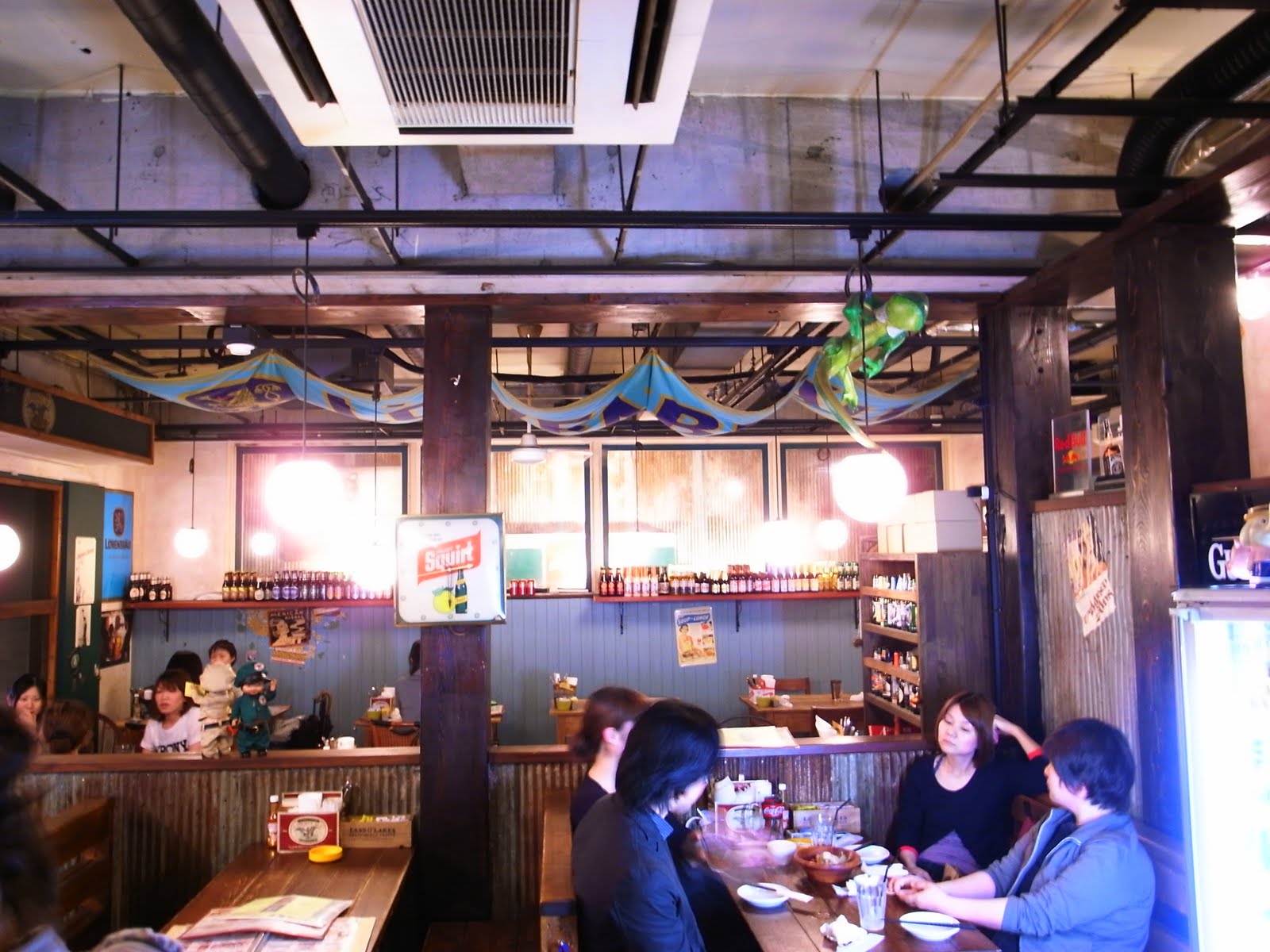
I love "Village Vanguard" and burgers as much, so it was a no-brainer for me when they opened a burger joint 5mn away few years ago. Though I find the food and most of the all the beers expensive, I recommend this place to anyone craving for a burger. Don't forget "Frisco", which offers a more authentic delicious charcoal grilled version.

Village Vanguard Diner

If you visit the texmex looking restaurant, you will probably be amazed at the service the kids working there offer you. It is the BEST service I know in Japan among any kind of casual western-style eateries. They are so attentive to details and so eager to make you enjoy your fare, sometimes it might even feel like it's too much. But too much is better than too less, so no complains on that side, and my hats-off to the director of personnel.

They also have a very decent list of popular to less know American local beers (by the bottle) that should make for a nice break if you've got a little tired of the Japanese beers. Only problem: the bottles all cost around ¥800, so it's not like you can order one after an other.

Avocado laver burger

Now, the food: they have a menu essentially comprised of Taco Rice or Nachos-like texmex fares but the stars of the joint are definitely the ten or so burgers they offer, ranging from the "Mushroom and garlic cheeseburger" to the "Avocado laver burger (with Nori dry seaweed)" or the "Pepper∧ cheddar melt (with a fat piece of bacon!) "ones. All come with french fries on the side, which you will want to ask them not to salt if you're low on that condiment. I think they tend to over-salt them, so don't hesitate to let them know in advance if you want to keep it eatable.

Authentic Burger with Cheddar cheese

You can obviously order the "regular" burgers, but I usually go for what they call the "Authentic Burger", which simply consists of a 200g beef pate, cheddar cheese, fresh tomato, grilled onion, all sandwiched with two big loaves of Graham bread.

The salt and peppered meat is unbelievably juicy. Good stuff. There is 200g of it on your plate so you should be happy if you're a meat eater.
As you can see from the picture, they're quite generous on the cheese and manage to melt it just the way you want it. The perfect definition and example of "guilty pleasure".
There are big slices of tender grilled onion hidden under the meat, which provide a timely sweetness to the otherwise salty dish. Same goes for the slightly sweet bread, which I think goes very well with the beef pate and the vegetables, though I wish it could be a hint more toasted.
An overall very satisfying and filling dish, but at a cost: ¥1,580. Given the size of the beast, you can't be too demanding, but if you order a beer the bill adds up to over ¥2,300 so I still think it could and should be cheaper.

Village Vanguard Diner is open everyday from 11:30am to midnight
03-3481-5620
Setagaya-ku, Daita 6-3-1 B1
click here for a MAP

Kitchen West (Yoshoku), Shimokitazawa

After eating at "Roxanne", we got in the mood for some more authentic Yoshoku (shortened from Seiyoshoku, literally Western cuisine) and therefore decided to visit the next day the Yoshokuya (Yoshoku restaurant) "Kitchen West" in business since 1962, that is a little bit before the Tokyo Olympics. It is located next to the wonderful Ramen joint "Ichiryu", so in case you'd still be a little hungry after your lunch or dinner there, you know where to go...

A quick recap for anyone not familiar with Yoshoku. This Japanese remix of so-called western cuisine is said to have appeared during the Meiji Period, when Japan opened to and started to embrace the European civilization as a mean to develop the country. Though most of the dishes are European recipes adapted to the Japanese palate and available local ingredients, some dishes like Omu-Raisu (ketchup flavored rice stuffed omelette) or Chicken Rice (not to mix up with the Hainanese Chicken Rice or the Arroz Con Pollo in Latin America) are somehow "originals".

I have been a big fan of Yoshoku since I was a kid, and everytime I think about that cuisine, I can not but help thinking with amusement about the fake plastic food samples in the displays, most notably the gravity-defying"fork and spaghetti".

The relativelay small "Kitchen West" doesn't have any of those amazing displays but on the otherhand, its dyed-blond chef and the old lady serving customers have a pretty nice menu to sample from. I actually recommend their ¥700 A Set which comprises a Soseiji, a Kisu Furai and a Hanbaagu (sausage, deep-fried sillago and Japanese-style hamburger steak) or the ¥850 B set with its Hanbaagu, Pooku Katsuletsu and Ebi Furai (hamburger, deep-fried pork cutlet and deep-fried prawn) as those combos allow you to try several of the most popular Yoshoku items in one go. Both set come with a plate of rice.

B Set

The flavorful demi-glace glaze covered hamburger steak is super tender and makes you want to order a refill for your plate of rice. God, those two combine marvelously.
The pork cutlet is a fat-free piece of fillet that is thinly breaded and goes very well with the Worcestershire-style sauce they add on top. Another killer with the rice.
The prawn is good, but not as memorable as the hamburger or the pork. I just wished the breadcrumbs were crunchier and that they did not taste so much like oil. It's actually probably better to eat the shrimp first while it's still freshly fried as it prevents it from feeling a little "tired" and humid from its own heat.

Close-Up of A Set (Salligo and Sausage)

The salligo is not fishy at all, perfectly deep-fried, allowing you to enjoy the nicely cooked batter and the tender and fresh savory white meat. A Yoshoku classic that you shouldn't miss. Add some sauce on top for an added taste kick.
The sausage actually tastes like what a pork sausage should taste like, which is a good thing, as you will often be served some weird fish or mixed meat sausages that after so many years in Japan I still haven't got accustomed to.

It would be a sin if I did not hit the spotlight on the supporting role played by the spaghetti on the side, so let me allocate one or two sentences about them. They are probably boiled and then quickly sauteed with curry powder, and though it may taste and seem a little strange at first, they somehow get more and more addictive as you work on them. One other thing I like about them, and I know it's not how pastas should be, but spaghetti at Yoshokuya are often doughy and lukewarm and that's great: the perfect supporting role. Too bad they're only second-bananas in "Kitchen West" as I could actually devour a whole plate of them.

The great curry flavored spaghetti

One other usual favorite is the Kani Kuriimu Korokke (Japanese-style crab flavored savory croquettes), a real calorie bomb. We ordered this one to complete our dinner though frankly you can get pretty full with the set only. Alike the deep-fried prawn, be sure to attack it while it's still burning hot as it will allow you to fully enjoy the "umami" of the savory bechamel sauce, and the brown glaze on top won't have enough time to soften up the crumbs. The crab flavor is delicate and probably less strong than the average. Beware though: it's really hot.

Kani Kuriimu Korokke

I recommend this place to anyone interested in Yoshoku. It's tiny and you might get out of the joint smelling like food from a mile away, but the food is cheap and good, and the service satisfactory.

Kitchen West is closed on Fridays, and open the rest of the week from noon to 21:30pm.
03-3485-3693
Setagaya-ku, Kitazawa 2-13-11
Click here for a MAP