Showing posts with label Ramen. Show all posts

Nakamuraya @ WeST PArK CaFE (Ramen and Burger), Shimokitazawa

East Meets West

This has to be one of the weirdest combination of food I've seen in a while: Ramens and Burgers served in the same establishment. Then again, if these were served in a random restaurant, I'd be VERY suspicious about the outcome, but we're talking about a famous Ramen joint "Nakamuraya" and an expat favorite West Coast style restaurant "WeST PArK CaFE" collaborating, so it got my taste buds rather excited.
By the way, you should know that the owner of "Nakamuraya" (famous for its salt-based broth), Shigetoshi Nakamura, has spent some time in the US as a teenager and also opened in 2009 a Ramen joint in Los Angeles called "Ramen California". It should therefore come as no surprise if he has been interested in mixing genres and cultures again.

The stylish shop opened beginning of January and I can't say it's been drawing crowds yet. Does it need more word-of-mouth or is it just potential customers being dubious about the combination of cuisine served there? I'm not sure yet. All I can say is that the burger I ordered was pretty good, so chances are the bowl of Ramen is worth it too. But that'll be for another occasion.

Stylish interior
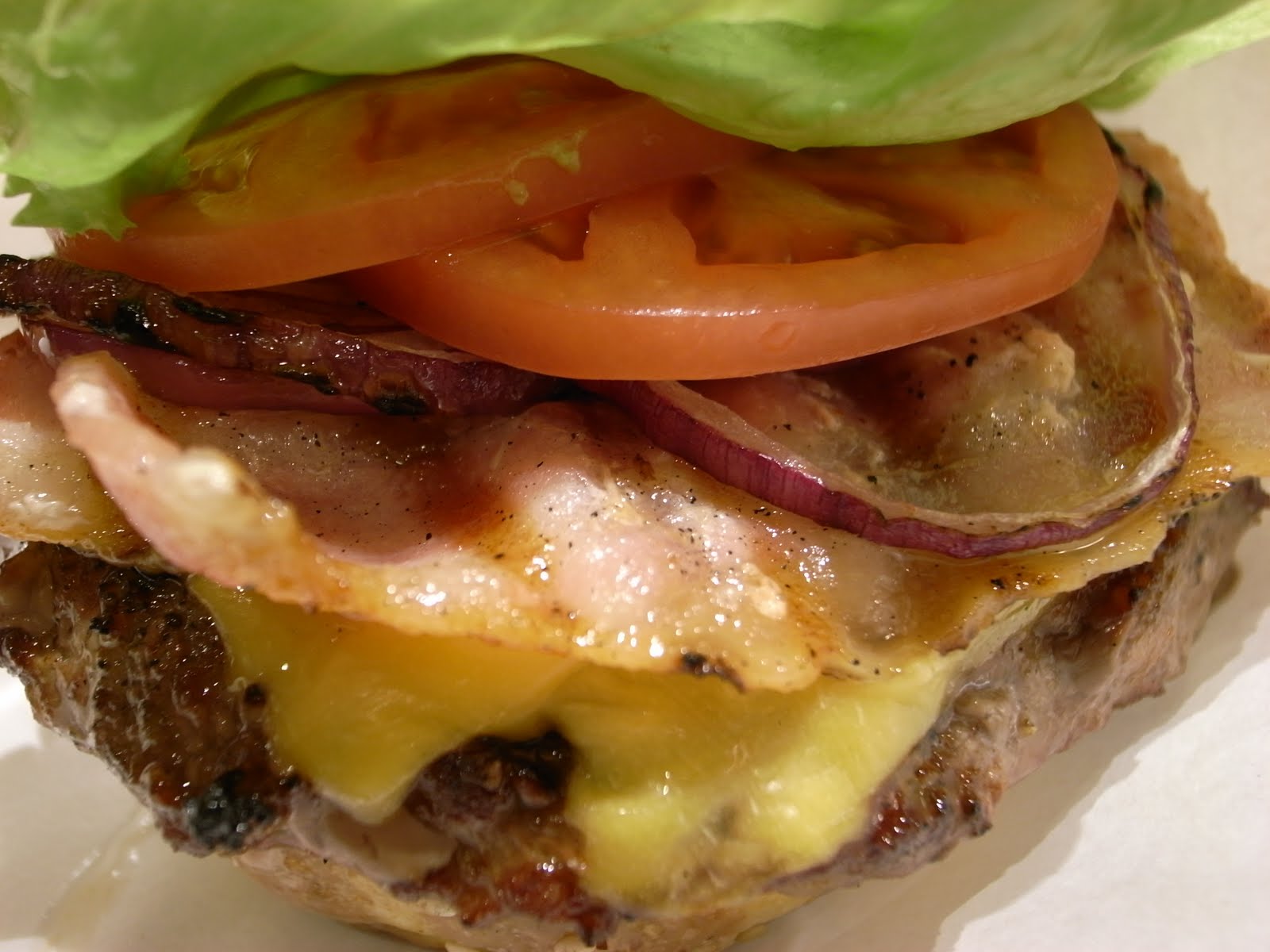
There are two chefs in the kitchen: one seems to be in charge of the Burger menu and the other one looks at the Ramen noodles. Though I've been to WeST PArk CaFE countless times, I've never tried their burgers, so I decided to have the former cook get to work by ordering the Bacon Cheese Burger. (For your information, every burger comes with some fries)

The Bacon Cheese Burger

In about ten minutes came a rather tall burger with a promising look. The pictures don't do the burger justice in terms of size and color, but I can guarantee you that from the fresh tomatoes, lettuce and grilled onions to the juice-dripping beef pate and melted cheddar cheese, everything was pretty mouth-watering. The white sesame-topped buns are quickly toasted over the grill and (if I remember well) a hint sweet. Good bread. As far as I know, WeST PArk CaFE bakes its own bread so I would assume the bread here is homemade as well.

The buns soaked in meat juice

The charcoal-grilled pate is made of 100% Australian beef and there are no eggs, bread crumbs neither onion mixed in the meat : just plain meat so you can appreciate its taste. The beef was good and juicy, seasoned with salt and pepper only. There was a little bit of mayo-like sauce on top of the lettuce, but that's the only seasoning I could find besides what I mentioned. If you're the type of person who likes his/her burger simple with as little sauce as possible, this place should suit your taste.

The long and sweet French fries

There were not a lot of French fries on the side, but the few ones on the plate were thick and a good 4 to 5 inches in length. They tasted a little bit like Japanese sweet potatoes, so it was slightly surprising at the beginning. Good nonetheless.

The Bacon Cheese Burger costs ¥1,400 so it's not the cheapest burger around but it was a satisfying dish, both size-wise and taste-wise. Will try to review the famous Ramen next time!
In the meantime, Bon Appetit!

Nakamuraya @ WeST PArK CaFE is open everyday from 11:30am to 23:00pm (L.O. 22:00pm)
03-3410-1120
Setagaya-ku, Daizawa 5-32-13
Click here for a MAP

Ramen Yajirushi (Ramen), Shimokitazawa

There are a few spots quite tough to find or get to in Shimokitazawa, like the infamously hard to spot "Frisco" (which unfortunately closed last week as the old building it was in will be destroyed), and this Ramen joint "Yajirushi" that I am featuring today is one of them. I am not sure how long it's been there but I have NEVER noticed it.
True, I've seen its red flag saying らーめん (Ramen) on the side of the street probably a good several hundred times, but never seeing the actual joint close-by (or at least at the end of the alley where the flag is) made me not pay attention to the place at all.
Just as a search result not on your Google top page is unfortunately almost irrelevant, a restaurant which is not close by its billboard or sign has a chance of remaining largely unnoticed. Or, like "Nasu Oyaji" which is slightly away from the main street, opt for a fun sign such as "we are 64 steps from this sign" and you know that some people will end up in front of your shop just for the sake of trying the little challenge.
Alright, enough digressing.

Ramen Yajirushi (Yajirushi means "arrow", and I must have completely missed it...) occupies one of the ground floor rooms (furthest from the street) of a really average looking apartment, and can probably sit 10 people at the counter. The owner/cook is mute as a fish and I had to wonder whether the meal ticket distributor at the entrance was another way for him to avoid communicating with customers.

There were few press clippings outside the restaurant recommending the Shio Ramen (salty Ramen) so that's what ordered with a topping of Moyashi (soy sprout) and an Aji-Tama (simmered egg).
The said bowl of noodles got to me in less than five minutes and I have to say that the initial tasting of the transparent soup was a pleasant surprise. The broth is a simmered blend of Genkotsu (the succulent pork knee joint bone which resembles the human knuckle, thus dubbed the equivalent in Japanese), Torigara (Chicken carcass), vegetables, Niboshi (dry baby sardines) as well as Sababushi (dry mackerel shavings), and manages to keep a delicious balance between the meat and fish aromas (the later is stronger). I would not recommend that you down it though, as there was a relatively consequent amount of fat floating on top the soup, capable of boosting your calorie intake for the day before you know it.

The homemade white-colored square noodles are about 1.5mm thick and have a nice firmness. A sign on the counter says that the dough contains some alkaline water, which explains the consistency, as such water is usually added to give the noodles a harder bite. I loved it, as they somehow had a hint of jelly texture to them.

The toppings were all good with a special mention for the very tender and melting in your mouth Chashu (Chinese style pork bbq), once again homemade, stewed six hours before being marinated in a special Shoyu-based glaze for an hour.
I also loved the perfectly simmered egg, which unfortunately I would have preferred more half-boiled. Mine was tasting perfectly but was 90% boiled when I love them runnier.

Don't go to this place thinking you'll be able to practice your Japanese as you will most probably end up not exchanging a single word with the cook (not that he seemed like a bad guy). However, I can recommend the Shio-Ramen. The place seems famous for its Tsukemen (dipping noodles in a separate bowl of hot broth) as well, so please give it a try if you feel like it.

Ramen Yajirushi is closed on Tuesdays and open the rest of the week from 11:30am to 21:00pm
Setagaya-Ku, Kitazawa 2-28-7
03-3468-1538
Click here for a MAP

Rishin (Ramen), Shimokitazawa

I tried the other day this new ramen joint which opened last March next to the nice Izakaya (food serving japanese style pub) "Zakoya". "Rishin" is the offspring of the Ramen shop "Kunishin" in the northern Nagano prefecture, and the name of the restaurant comes from the owner's daughter name (which contains the chinese character 莉 "ri").
The place looks nice, japonesque, and rather classy for a noodle joint with its black wood structure inside and outside the building. They do serve drinks as well, making it a ramen meets izakaya hybrid eatery.

I went for their recommendation "Negi Chashu Men" (ramen topped with leek and chinese-style bbq pork) which I supersized for free, as they let you
a) supersize the noodles or
b) have a bowl of rice or
c) have a bowl of rice topped with Tororo (grated Japanese Yam potato)
with no charge.

The big bowl that got to me was rather impressive in size and the first thought was that they're quite generous on both the white leek and the pork.

The soup is light brown, quite dense and salty with a thin layer of lard floating on the surface (not as much but a little bit like the famous chain Kazuki). I assume it is a Shoyu and Torigara (chicken carcass) based broth: not bad, except that the pork is very salty, so if you don't have a glass of water to wash it down, you're on for an intense NaCl experience.
The pork, though too pungent, has a very nice texture, keeping a good balance between the firmer flesh and the tender fat. Really too bad it felt so salty.

The mountain of thinly chopped white leek is seasoned with Rayu (chili infused Chinese style vegetable oil), the whole thing combining really well with the noodles and the soup. Just make sure you don't have any meeting or date on the same day as you're guaranteed to knock out your precious interlocutor with your breath.

The squiggly noodles are about 3mm wide, slightly flat and with a medium firmness. I think they go well with the dish, but a hint more koshi (firmness) might add a little more character to the dish. I'll be fair to the shop though: I did spend some time tasting the pork and the leek before I attacked the noodles, so maybe they got softer during that time.

They do have other recommended noodle dishes as well, so if you're interested, please give it a try. The ramen I had was so-so: I found the whole thing too salty and dense, but might be good if you're into pungent broths!


Rishin is open everyday from 11:30am to 15:00pm and 19:00pm to 01:00am
03-3466-0398
Setagaya-ku, Kitazawa 2-9-21
Click here for a MAP

Mintei (Chinese), Shimokitazawa

"Mintei", the epitome of a cheap eatery in rocking Shimokitazawa, is one of the, if not the most famous joint in the neighborhood. It is not the oldest establishment (if you're looking for an old one, check out the Japanese-Chinese "Rairaiken"), but it has been open for more than 40 years, which is quite old for Japanese standards.

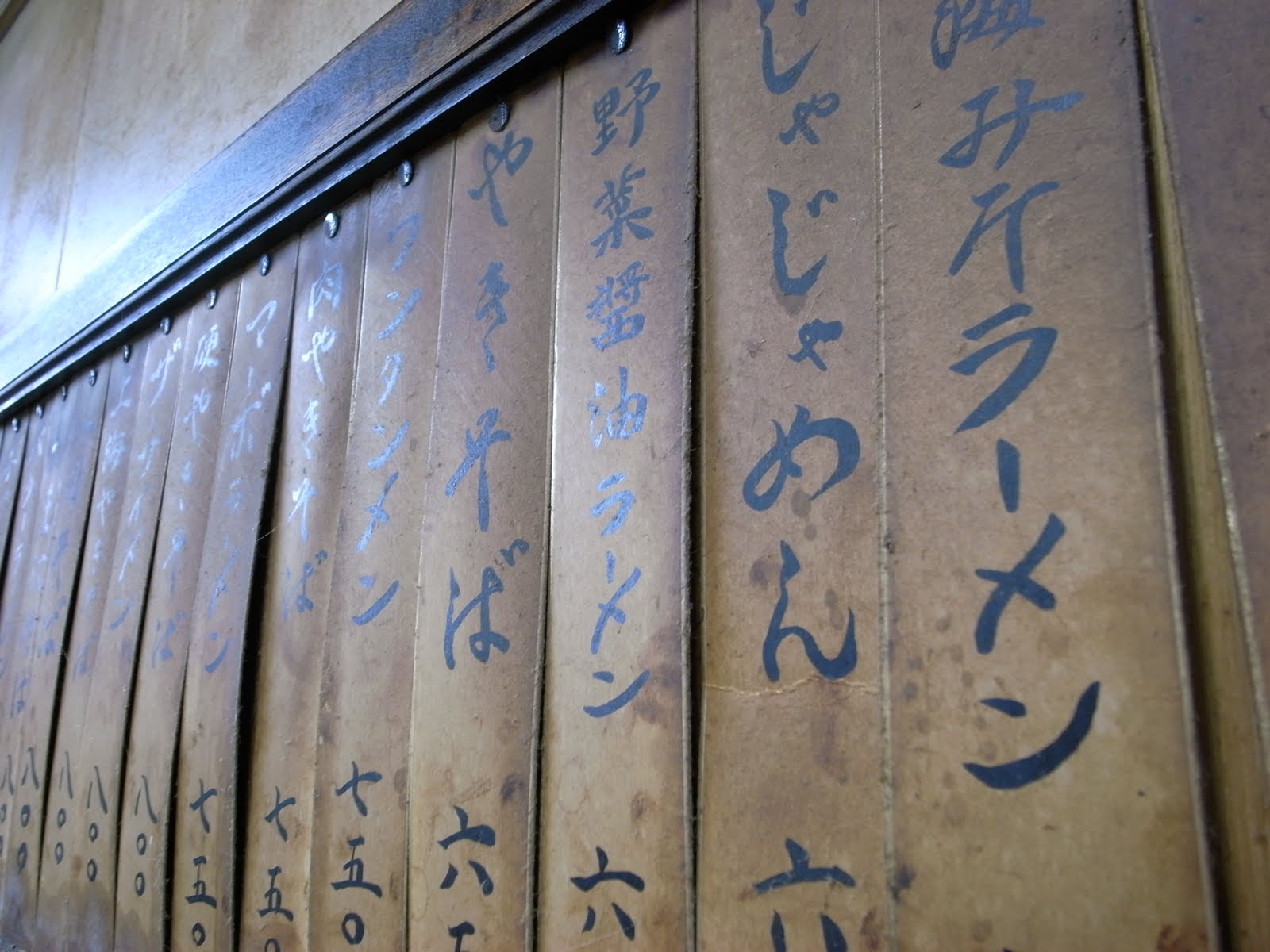
the worn-down old menu plates on the wall

I first went to "Mintei" when I was a teenager, which is a LONG time ago, and the place has not changed at all since. The only thing that has changed is probably the color of the several celebrity autographs on the walls, that have yellowed over the decades. One autograph that is worth mentioning is the one on top of the counter by the entrance, signed in 1989 by the vocalist from legendary punk rock band "The Blue Hearts", Hiroto Komoto.
Shimokitazawa being the THE indie/rock town of Japan, a lot of kids aspiring to be future stars, work part-time in some of the restaurants in the area before or after rehearsing at studios. Hiroto Komoto, one of them, used to work in Mintei in the 80s. The tradition is still holding strong, and if you ever visit this joint, you will probably see musician-looking-kids in the kitchen.
The customers are a mix of young couples, students, musicians, and middle-aged people from the neighborhood looking for a cheap meal.

the old autographs above the counter

Another thing worth noting is the rather "punk" catch-phrase outside the restaurant amusingly citing the joint as "serving the 3rd best food in the world". The reason why it's not the best or second best is, according to Mintei, because:
1. the best food in the world is the "Ofukuro No Aji", that is your mum's cooking (check out 2nd paragraph of this post for a little explanation)
2. the second best is your dad's shin taste when you bite on it (a Japanese expression saying "bite on your parent's shin" means to sponge off one's parents)
3, the third best food in the world is their Ramen

As you can see, one thing they do not lack is a good sense of humor. Now, is the food as good as the humor?

Well, I'd have to say it's not as great as what the joint's reputation would make you believe. I have never tried anything other than the "Edokko Ramen" (Edokko, literally kid from Edo, relates to a person born in Edo, the old Tokyo; such person is often perceived as being cheerful, in your face and straightforward), which consists of a big bowl of Shoyu Ramen with homemade Kimchi (Korean-style fermented cabbage with chili) on top and the "Wantan Men" (ramen with Chinese dumplings Won Ton), making it difficult to give you a constructive review of the place, but the house specialty "Edokko Ramen" is rather mediocre.

Edokko Ramen

The soup tastes like a lightly salted Torigara (chicken bones) and shoyu-based broth. It is relatively clear and not too oily. The soup tastes actually much better than the rest of the ingredients: the boiled Aona greens are very plain in taste and a bit too flabby, the large pieces of Chashu (Chinese style bbq pork) are fibrous and too low in salt.
The Kimchi is a little too strong in garlic for me, when I would have loved it slightly more sour and chilihot. It seems by the way quite unusual to name a Ramen "Edokko" when its particularity is the topped Korean item.
Last but not the least: the noodles, though ok in taste, are way lacking in Koshi, or firmness. I usually don't put much emphasis on the Koshi, but when the rest is average, you want at least your noodles to have some sort of character.

The Wantan Men's broth is on the other hand quite salty (even too salty I think), so only order it if you're ready for it.

As you can see, I'm not a big fan of their food. Once again, I've only tried a couple of Ramen dish, so that's not enough to give you a fair review, but so far, it's been mediocre. It will definitely give you an idea of what a lot of Ramen used to taste like all over Japan back in the good ol' days...

What's more interesting is definitely the Showa-era feel that the place resonates.


"Mintei" is closed on Mondays, and open the rest of the week from 11:30am to 23:20pm.
Setagaya-ku, Kitazawa 2-8-8
03-3466-7355
Click here for a MAP

Senrigan (Ramen), Higashikitazawa

If you're a Ramen eater, I strongly recommend you go to this place: it's good, filling and fun. OK, it's a little out of the way and you will have to walk a little bit, but that resulting exercise might actually be necessary and beneficiary when looking at the amount of calories and food involved in that one bowl of noodles.

It took me a while to first enter this place, as the orange and yellow nameboard outside saying "Ramen Senrigan Ninniku" (Ninniku meaning garlic) made me think that there would be too much of that Dracula-killer in the soup. I still decided to give it a try one day, as I kept seeing people flocking in the place. Since then, I've been a fan. It's cheap (regular Ramen at ¥680), it's filling with its 300g worth of noodles and it's fun with all the mountain like toppings you can add for free.

You first buy your meal ticket at the vending machine. The choice is simple and limited: "Ramen" (¥680), "Ramen" supersized (¥780), "Buta Ramen" (Ramen with added Chinese-Style pork bbq Chashu at ¥850), "Buta Ramen" supersized (¥950), "Buta Dabulu Ramen" (even more Chashu! at ¥980) and finally the gigantic "Buta Dabulu Ramen" supersized (¥1080).
To make it easier for you, I'd recommend you go for the regular Ramen which will most probably largely satisfy your hunger.

The mountain of Moyashi

The regular Ramen's toppings consist of boiled Moyashi (bean sprout), Kyabetsu (Chinese cabbage) and Chashu. However, when the dish is almost prepared, the cook will call out your seat number (written in front of you on the counter) and ask you if you want some garlic in it.

Seat #3 waiting for the call

Check out the following video to see how that works and the impressive topping of Moyashi:


To which you can reply Nashi (for no thanks), Sukuname (for a little) and Onegaishimasu (for yes please)
You also have a choice of free toppings:
Yasai Mashi (literally More Vegies)
Abura (more fat)
Karame (stronger broth)
Kara-age (deep-fried Tempura batter Tenkatsu with hot chili powder)
Just ask for what you want, and they will add that on your bowl.

Regulars seem to go for Zenbu Kudasai (please top everything), but I tend to like my noodles simple, so I always only ask for Yasai-Mashi and Ninniku Sukuname to make myself feel better knowing that I did order "healthier" vegetables...
The result is colossal, as you can see it from the pictures.

The rather thick, almost milky-textured Tonkotsu(pork bone) and Shoyu based broth is very rich and surprisingly not garlic flavored. Add some garlic only if you like it and you want a little kick, as the soup is well good enough without. I have seen some customers down the whole artery-clogging soup, but I don't have the courage to imitate them as it's already tough enough to finish the ingredients...
The noodles are brown-colored (just like Sobas), quite thick at 3-4mm (not different from the Moyashi width) and with a good koshi (firmness). As you have to fight through 300g of them, you're pretty much full when you've finished chewing them.

The three thick slices of Chashu are wonderfully tender and melt in your mouth, if they haven't already disintegrated while sitting in the soup. They are a bit salty but the combination with the boiled Moyashi and Kyabetsu is good.

No explanations will come close to actually trying it, so if you're into Ramen, the detour is definitely worth it. For your information, "Okame" and "Ramen Yamate" are in the same street.

Senrigan is closed on Mondays and open the rest of the week
from 11:00am to 14:30pm, 17:00pm to 22:00pm Tuesday through to Saturday
from 11:00am to 14:30pm, 17:00 pm to 21:00pm Sunday and on National Holidays
Meguro-Ku, Komaba 4-6-8
03-3481-5773
It's about 500m from Higashi-Kitazawa (Odakyu Line) and Ikenoue (Inokashira Line), or 15-20mn walk from Shimokitazawa
Click here for a MAP

Ichiryu (Ramen), Shimokitazawa

After having spent more or less my entire life in Japan and slurped countless bowls of Ramen, I don't get carried away easily anymore over that dish. However, my encounter with the "Chuka Ramen" (Chinese Ramen) at "Ichiryu" has been one of these rare occasions when I got all excited.

As you can see, besides the topped Beni Shoga (thinly cut pickled ginger) , nothing seems extraordinary about this bowl, with the very usual Chasu (Chinese-style bbq pork), Menma (Japanese style Sungan), Moyashi (soy bean sprout) and Negi (leek) decorating the noodles.

The restaurant too is normal looking: the very reminiscent of Showa Era red long counter, the red round stools, the cheap metal Hashi (chopsticks) holders, the ever present condiments, the old analog TV towards the entrance. It's clean, neat, with the old man and his white worker hat cooking in his tiny kitchen while the lady takes care of all the service; really nothing outstanding in this typical old school noodles joint. Until you have a closer look at the soup...
And then, you can not but exclaim"Wow, the soup is gold!" And I'm talking about a beautiful gold, shiny and warm, which the pictures can unfortunately not translate. A gold color which I have never encountered in any of all those joints I have visited. Zipang, I found you!

OK, you heard me about the color...Now, how does it taste? Well, it tastes REALLY good, though a hint too salty maybe. It's a slightly thick Tonkotsu (pork bones), Torigara (chicken carcass) and shoyu mixed broth which you would happily down if you did not mind exploding your calories intake limit for the week. Oh, boy, what a guilty pleasure that would be!
For your information, the master learned this recipe from his brother, who in turn acquired it from a locally famous joint "Ichiriki" in the Fukui prefecture. Too bad Fukui is more famous for its numerous nuclear plants than its rather unknown noodles...

The four slices of Chashu are also worth the mention, slightly dry and fibrous at first but quickly dissolving in your mouth as you work on them. Like all the other toppings, they're very humble, rather low in salt but well done. A nice and harmonious team work between all the ingredients to give you the best possible Ramen experience.

The moyashi (sprout) could personally be a little less boiled in order to give you a hint more of crunchiness but as I told you, they're being low-profile so you can probably enjoy the pungent and dense broth to the fullest.

You will often find Beni-Shoga in a Kyushu Tonkotsu ramen, but I think it's quite rare in northern Japan recipes. It is after the golden soup, the next nice surprise appearance in this Ramen as it gives you that additional freshness and sourness that smoothes the broth in an amazingly very delicate way, not to mention the pleasant to the eyes color combination with the green chopped leeks.

Last but not the least, the squiggly noodles: medium firmness and diameter with a nice pale yellow color. They taste good and combine well with the soup when slurped on. One thing: go only for the Oomori large size (¥800) if you're hungry as the supersized bowl comes with quite a lot of these noodles.

Ichiryu is open everyday from 11:30am to 22:00pm
03-3466-1671
Setagaya-ku, Kitazawa 2-30-11
Click here for a MAP

Ramen Yamate (Ramen), Komaba Todaimae

This place is a little far from Shimokitazawa, as you will need to walk for about half an hour, but it's quite worth the walk if you are a Ramen addict. Actually, "Ramen Yamate" being located by the Tokyo University Campus, the promenade can be quite pleasant as you could cut through the verdant school grounds to get there. The mix of old brick academic buildings and modern structures looks quite nice on photos, so if you're an adept of that particular visual art, that's another reason for you to wander through the premises.
If you have no interest in walking or photography, that's still OK, as the bowl of Ramen is interesting and good enough to go all the way there. It is also a big favorite among the college's students and you will see many of them in there.

"Ramen Yamate" kitchen

What's so special about this place is the noodles, and most of the people will agree with me in saying that they are pasta-like: they have the egg-yellow color, more or less the taste and definitely the firmness of slightly al dente Italian pasti. I think that's quite original but I know for a fact that some hardcore Ramen-eaters find that a blasphemy. Well, that's too bad for them, as the "Togarashi Ramen" (chili ramen) I had yesterday was excellent.

"Togarashi Ramen"

The broth in Ramen Yamate is Tonkotsu-based (pork bone), to which they add some Tori-Gara (chicken carcass), Konbu (tangle), garlic, ginger and Shiitake mushroom, all of which they simmer for 24 hours. This makes a light-flavored Tonkotsu soup that I find very appetizing.
Friends from college who are readins this blog (thank you) might remember our favorite "Akashiroya" in Yoyogi-Uehara (the place is gone now). Well, "Ramen Yamate" is the mother shop and tastes quite the same.

Yamate's most popular dish is the "Yuki (snow) Ramen" which consists of that basic broth with toppings of roasted garlic and onion, and a final thin layer of lard on top of the soup. That light blanket of fat, which supposedly adds smoothness to the broth, looks like snow, hence the name of the dish.
As mouth-watering as that sounds, as I said earlier, I went for the "Togarashi Ramen" which is a hot version of the basic broth, with added chili in it. The soup looks hellishly red and spicy, but that's really on the surface, and they manage to keep it very eatable. The soup actually tasted so good that I even thought for a while of downing it, but fought such calorie mega-intake with courage.

Togarashi Ramen Soup

The ramen comes with Menma (Japanese style Sungan) and a slice of Chashu (Chinese-style bbq pork) that somehow tastes a little bit and has the fibrous texture of canned tuna. Both toppings are a little too low on salt for my liking, which is a shame as they definitely need more flavor to compete with the rich spicy soup

The pasta-like noodles are freshly made on site (the "noodle factory" is next door) by the manager and were originally studied and designed as to give the best Nogo-Doshi possible (literally Passing the Throat), an important notion in Japan where firmness of food can be a matter of lengthy heated discussion. Nodo-Goshi can designate anything from firmness, smoothness or fluidity, but is really basically about how easily and enjoyably you'll down the stuff.
Even after more than 30 years in Japan, Nodo-Goshi is still a slightly difficult notion to grasp for me, so let me just say that their noodles provide a nice resistance, are tasty and are a pleasure to swallow with a little bit of soup. Once again, Ramen purist might tell you that they do not mingle well with the broth, but that's the least of my concerns.

Whether it has something to do with the fact that the noodles do seem a little "Italian", I don't know, but Yamate also offers a "Tomato Ramen" (left on the picture above), with Italian tomatoes, wine, aromatic herbs and chili-infused Olive oil, which might be a wonderful match for the "pasta". If you're in a challenging mode, go crazy...

"Ramen Yamate" (mid to far right) and the "Noodle Factory" (left)

Ramen Yamate is open everyday from 11:30am to 02:45am
You can walk there from Shimokitazawa (30mn), Higashi-Kitazawa (20mn) on the Odakyu Line or 10mn from Komaba-Todaimae (2 stations from Shimokitazawa on the Inokashira Line)
Shibuya-ku, Tomigaya 2-21-7
03-5453-7290
Click here for a MAP

Yasube (Tsukemen), Shimokitazawa

In Japan, it is a very popular custom to go slurp some noodles late at night after a drinking/clubbing session. I am not sure why people do that, as you are usually 1) very drunk or 2) already too full to appreciate the dish, not to say that it sure does not help your hangover the next day either, but I do follow the tradition myself as well time to time.
That is exactly what I did yesterday after a whole day of total gastronomic debauchery at a good friend's house. As I suddenly felt like downing a bowl of noodles, I walked towards the Tsukemen shop "Yasube" which I had promised to cover in a previous post about "Mitsuyado Seimen".
The tiny place was full (as always) when I got there and had to queue for about 10mn, during which I bought my ticket from the vending machine. I opted for the regular 220g Namimori Tsukemen which was served to me few minutes after I sat at the 7 seats counter.

The first impression I had is that the shoyu-based broth you dip the noodles in is surprisingly fishy. They are probably simmering a lot of Ni-Boshi (dry baby sardines) and Katsuo-Boshi (dry bonito) to bring that much flavor. I got worried that it might be too fishy for me, but repeatedly dipping the wet noodles in the soup quickly waters and smoothes the broth to a very nice balanced flavor. The broth is also quite hot, as they add a decent amount of chili powder in it, but it is just enough to stimulate your appetite. For those of you who like it pretty hot, you can order their Karami-Tsukemen, which features a rayu (chili infused vegetable oil) added soup.

The bouillon comes with bits of nice and soft Chashu (Chinese-style bbq pork), some very good Menma (Japanese style Sungan) that adds a pleasant saltiness to the whole, a lot of leek and a big sheet of dry seaweed Nori.
Though I haven't tried them, they also offer some Katsuo-Bushi powder for added fishiness and some fresh onion for those who want extra freshness.

Now, let's get onto the belly filler. I am not sure what it means, but a notice on the menu says that they add water to the dough so that the noodles keep a nice firmness until the end. What I did feel on the other hand is that they seem quite fluid in your mouth, and that definitely made them easier to chew and swallow. Whether that was due to the extra H2O, I don't know, but despite the enormous amount of food I had ingested during the day, I had NO problem whatsoever in devouring them. If you are hungry, the middle size Chu-Mori (320g) and big size Oo-Mori (420g) are all priced the same as the regular one I ordered, at ¥720. I would assume that the Chu-Mori is within the reach of anyone's stomach so don't be scared and go crazy.

In retrospective, I found the tsukemen at Yasube easier to eat, and the broth more delicate or less salty than at Mitsuyado Seimen. Of course, this is a more classic Tsukemen, whereas Mitsuyado is focused on the original Yuzu flavor of its soup. You could actually try and compare both restaurants should you spend your whole day wandering the streets of Shimokitazawa...

Yasube is open everyday from 11am to 02am, though they will close as soon as they're out of noodles. They also offer Ramen in case you're more into having your noodles in the broth from the start.

03-3422-2711
Setagaya-ku, Kitazawa 2-12-15
Click here for a MAP

Taisho (Chinese), Shimokitazawa

Today's post is about the cheap Chinese joint "Taisho", which has been offering Ramen noodles, Chahan (fried rice) and Gyoza (minced meat and vegetables filled pan-fried Chinese dumplings) among other things for a quarter of a century now.

The shop is managed by an adorable couple, whose husband I first met at "Bear Pond" where he is a regular along with his 8 years old French bulldog.
Although I had been passing in front of their restaurant for years now, I was never tempted to go try it. The slightly cheap looking exterior never looked appealing and a hand-written poster on the door saying they serve "Gyoza without garlic" somehow seemed suspicious to me, as if they were trying to lure in customers with the promise of a fresh breath.

One day, after striking a conversation with the man over a cappuccino, and discovering that he was owning that restaurant, I asked him why he served the rare and odd garlic-less Gyoza (click here for a detailed article on the dish). The answer was interesting: Japanese soldiers and citizens in Manchuria during the war (shouldn't you be familiar with Manchuria's history, please click here) were so poor and lacking any fresh food that they started adding garlic to the local recipe and fry the dumplings in order to hide the foul taste of the half rotten meat. The spiced up version lived on when the Japanese came back to their homeland after the war, and eventually became the norm. So what he served was just what he believed to be the fried version of the original recipe.
I was so impressed by that history class that I decided to visit Taisho as soon as I could, which I did and which lead to another culinary discovery, the VERY ODD house specialty "Chikara Ramen".

The plate of 5 gyoza is at a very affordable ¥400 and the almost juicy and perfectly fried dumplings taste very good even without garlic. The master taught me another secret: instead of dipping the fried dumplings in the usual Shoyu (soy sauce)-Vinegar-Rayu (chili infused vegetable oil) mix, he uses Green Tabasco instead. I tried on the spot what I thought was blasphemy and it actually tasted good! If you ever order the Gyoza, try to ask him for the Louisiana sauce: he might be surprised, and yourself too!

Now, onto the most original Chikara Ramen. You need to know first that you will find in any Sobaya (soba noodles restaurant) menu the popular and personal childhood favorite "Chikara Soba" or "Chikara Udon". Soba being noodles made of buckwheat, whereas Udon are made of wheat flour, and Chikara designating the grilled Mochi (glutinous rice cake) that is topped on the noodles. Chikara means Strength in Japanese and refers to the belly-filling virtue of the cake.
The second thing you need to know is that you will NEVER find a Chikara Ramen, except at extraordinary "Taisho" whose owners have come up with the unorthodox menu in order to fill up the hungry belly of students, actors and musicians living in the area.
Being a major Chikara Udon fan and loving Ramen in equal proportion, you can understand how much of a no-brainer it was for me when I first saw that dish on the menu.
I'll be honest with you: I was a little bit disappointed with it because of the rather thin shoyu based ramen broth. However, I got to find out over time that this is a general rule in Taisho, where the Shoyu based, Miso (salty fermented soybean paste) based and Shio (salt) based ramen broths all taste rather watery. Most of the Japanese will probably agree in telling you that their ramen taste like the -natsukashii- good ol' ones you used to find in local Chuka (chinese restaurant), before Ramen became such a big culinary deal and thus strongly flavored.
Whether that's good or bad, I'll leave it up to your taste buds. The point here is more about enjoying the most unusual Mochi and Ramen noodles combination over an authentic late 20th century broth. I passed the disappointment phase and now regularly go catch up with the palate memories.
The Chikara Ramen comes with a sheet of Nori (dry sea weed), a slice of Chasu (Chinese style bbq pork), Menma (Japanese style Sungan) and leak.
I heard their Chahan (chinese style fried rice) is pretty good.

The place is well kept and very clean even after 25 years (they have not renovated the kitchen since opening and you will be amazed at its spotless state), as you can see from the above portrait. No, he was not posing in case you're wondering...


"Taisho" serves lunch and dinner, is closed on Thursdays and from about 14:30pm to 17:00pm on weekedays. They will be opened during the Golden Week Holidays that just started today.

The shop is easy to find at about 200m north from the West exit、little before Iseya if you're coming from the station.
Setagaya-ku, Daita 6-3-26
03-3468-9757
click here for a MAP

Tinun (Thai Ramen), Shibuya

OK, this is not about Shimokitazawa, but Shibuya is only one stop away by express train from Shimokitazawa, so that will be my first excuse. The second excuse is that I LOVE this place.

Tinun is a thai food restaurant chain which serves anything from noodle dishes to fried rice and curries. I once asked the smily probably-Thai staff what Tinun meant and they answered me "Ichiban" or number one in Japanese.

I'll be honest with you: I've never tried anything other than the below "Tom Yam Kung Ramen" but it's just SO good. It's nothing but some ramen noodles in a bowl of Tom Yam Kung (Thai Spicy Shrimp Soup) but oh my oh my, for anyone happening to like both dishes (like I do), the combination is lethal. And it's a very affordable ¥780.

I've tried this dish (I wouldn't be surprised if it were a Tinun original as I don't remember seeing this anywhere else before I first tried it there) in another Thai restaurant but it was a pale comparison. What makes the Tinun version so good is how very sour the soup is. I'm not sure whether it's lemon or lime or both that they put in the soup, but they must be putting a lot of it in there. They also manage to keep the delicately lemon-grassed flavored broth not too hot, which is wonderful as it lets you down the whole soup without having to a) sweat like a pig b) drink loads of water.

Toppings are kept simple with Moyashi (spout), chopped Coriander leaves, a slice of Chashu (Chinese style bbq pork). The yellow-colored straight and medium-width noodles seem to be Tamago-Men (added egg in the noodle batter) and they are in perfect harmony with the soup.

The place is small and you may have to queue a little bit around lunch time.

Tinun - Shibuya Dogenzaka is open from 11:00am to 23:00pm and is closed on Sundays.
Shibuya-ku, Dogenzaka 1-5-5
03-5459-2550
click here for a MAP

Tentemari (Ramen), Shimokitazawa

Tentemari is a Ramen shop a minute away from the station, in one of those exotic little Shimokitazawa streets. They specialize in the Tan Tan Men dish, a Ramen dish which is usually quite hot and spicy. The restaurant got featured on the quite popular "Dochi No Ryori Show" TV food show few years ago, cooking the dish for bunch of celebrities. Ironically, I remember not trying this place for a while because of the sign outside the restaurant saying they got on that program. Just thought it was lame.


But it was too bad for me, as it turned out they serve a pretty good Ramen, though I feel their powerfully sesame flavored soup has unfortunately gotten thinner over the years (which still doesn't prevent me from going few times a month!)

The Dian Dian Mian (Tan Tan Men in Japanese) is originally a Sichuan dish, and the popular Ramen (soupy) version is more a Japanese remix of the usually dry original Chinese recipe. The character for Dian (or Tan if read in Japanese) means carry or shoulder and came to be utilized in the name of the dish, since the streets vendors/cooks used to carry all their ingredients and utensils on a pole. Having to balance all that on the shoulders made a soupy dish not too practical. The soupy version also exists in China, but it's really the Japanese who popularized the "wet" version in the late 20th century.

Tan Tan Men with Bang Bang Ji

At Tentemari, you buy your ticket at a vending machine right at the entrance. You will have to choose between mild, hot and very hot and also what topping(s) you want on it (plain or with boiled chicken Bang Bang Ji style or with braised pork Kakuni and so on). I usually go for hot, as it gives the soup a nice kick. I happen to love Bang Bang Ji, so it's really a no-brainer for me as far as toppings are concerned.
The soup is quite thick, with a nice combination of zhi ma jiang (sesame paste with oil), chili-infused vegetable oil Rayu and Sansho (Chinese pepper). As with all Tan Tan Men, there is minced meat on top of the noodles, as well as radish sprouts and chinese cabbage Chingensai.
You get a free boiled egg with your noodles at lunch, and a complimentary bowl of rice for both lunch and dinner.

The above dish is far from being cheap at ¥950, not to mention that I find that the soup has lost a bit of its spicy kick, but I still recommend this place as a good introduction and good example of a nice Tan Tan Men.
They're also open until 3:30am, which is convenient when you need a bowl of Ramen to wake you up from a heavy drinking session at one of the many Shimokitazawa bars...

Remember "Tom's Kitchen" has a nice dry version of the Tan Tan Men should you be interested.

"Tentemari" is open from 11:00am to 03:30am from Tuesday to Saturday and from 11:00am to 11:00pm on Sunday, Monday and National Holidays
Setagaya-ku, Kitazawa 2-12-7
03-3418-6772
click here for a MAP

Mitsuyado Seimen (Tsukemen), Shimokitazawa

Mitsuyado Seimen is a new noodles place that specializes in a variation of the Ramen called "Tsukemen" ("Dipping Noodles"), a dish where the noodles and the broth are served in separate bowls, as in the below picture. You eat these noodles by simply dipping them in the broth.
Shimokitazawa has another Tsukemen place called Yasubee which is very popular, that I will try to cover on another occasion.

What differentiate "Mitsuyado Seimen" from other Tsukemen restaurants is that Mitsuyado lets you choose the temperature and firmness of the noodles. You will have 5 options: Kori-Jime (very cold and al dente), Hiya-Mori (cold just enough and firm), Numeri-Otoshi (room temperarure and quite firm), Atsu-Mori (as hot as regular Ramen noodles) and Yu-Dame (Kama Age style)

The restaurant recommends you to go for Hiya-Mori. I've never tried any other option, but Hiya-Mori does it for me.
You also need to choose the amount of noodles you want: 200g, 300g, 450g, 600g, 750g (+¥100), 1,500g (+¥400). The first time I ate there, I went for 450g and it was too much though I do eat quite a lot. Since then, I go for 300g which seems to be just enough. The price increases by an accesible ¥400 for the heavy 1,500g portion so try it if you're into a Sumo vibe!

I am not sure what the broth is made of but it seems to have some Tonkotsu (Pork bone and fat), some vegetables and some Niboshi (dried baby sardines) in it, which gives it a slightly fishy taste to it. The broth also has a distinctive Yuzu taste, which is the house flavor of "Mitsuyado". I personally find the broth to be slightly too rich, but I guess you can adapt by less dipping the noodles in it.
The broth will come with some Chashu (Chinese Style Bbq Pork), Menma (Japanese-style Sungan), Naruto (fish cake) and leek in it.

The above broth and the noodles is what you'll get if you order the regular Tsukemen (¥780), but if you feel like that is not enough, you can order their most-popular "Marutoku Tsukemen" (¥980) which comes with the below toppings:
Large Nori sheet (Dry seaweed), 2 big slices of additional Chashu, boiled vegetables (sprout, nira etc) that are hidden under the Chashu in the below picture and an Ajituske Tamago (flavored Egg)
When you're done eating the noodles, the staff will bring you some lighter broth which you add to your regular broth, so you can drink it like a soup. It's good but still quite rich and salty, so try not to down the whole thing as you might end up being thirsty for the rest of the day.

Mitsuyado Seimen is open 7 days a week from 11:30am to 01:00am (L.O. 24:00)
Setagaya-ku, Kitazawa 2-31-2
03-5790-8038
Click here for a MAP