Showing posts with label vegi ok. Show all posts

Kuumba Du Falafel (Falafel and Hummus), Shinsen

I know I shouldn't blog about eateries outside of Shimokitazawa, but there are few occasions when you get excited and want to talk about it. "Kuumba Du Falafel" provided me with such opportunity, so please bear with me on this post.

"Kuumba Du Falafel" is a 5mn walk or so from the "Shinsen" station on the Inokashira-Line, that is two stops from Shimokitazawa (or a good 30mn+ walk) or Shibuya. I have passed by the year-old restaurant so many times, it's hard to believe I never saw it. Sometimes it's really just about always walking on the "wrong" side of the street.

some dried fruit in glass jars on the nice "marble" counter

According to the Japanese owner, Kuumba means "to create" in Swahili, so "Kuumba Du Falafel" is an East African x French x Middle Eastern words to designate what simply is a Falafel joint. By the way, the shop manager I talked to is also the proud owner of "Kuumba International", a company specialized in the manufacture, import/export of essential oil and incense (an "olfactory", should you let me make this pun...), so the guy knows what he's talking about when it comes to smell and aromas.

The shop is clean, classy, light-filled thanks to big windows, with limited furniture, a single big marble counter for eating in and a kitchen in the back. The menu revolves around its specialty dish, the Falafel, served either in a HUGE pita sandwich or on a wrap all the ingredients yourself plate. They also have a Hummus plate that has to be good.
Should you not be versed in the Falafel, here's your Wiki article on the wonderful dish.
For your reference, the owner is a big Falafel fan who devoured the said dish in the four corners of the world, then tried all the Falafels he could find in Japan until he decided to cook them himself as he couldn't find his ideal version of the balls anywhere else here.

The plate, which is not cheap at ¥1,260 but oh so worth it, comes with two halves of Pita bread, a serving of hummus (chickpeas paste), a Tahini-based sesame sauce, five falafels, (what I assume to be) pickled Daikon radish, some marinated red cabbage, a HUGE salad composed of several herbs as well as cubed fresh tomato and cucumber, and last but not the least quickly fried eggplant slices. The picture doesn't give you any idea on the size of the dish, but believe me, it's quite big. If that doesn't fill you for the rest of the afternoon or the entire evening, well... there's a famous tonkotsu (pork carcass based broth) Ramen joint across...

the "balls"

The Falafels are an Israeli version (according to the boss), supposedly meaning that they are crunchier outside than say the more tender Egyptian version. The texture aside, the balls are aroma bombs of parsley, onion, garlic and god knows what and if you're into anything middle-eastern, you will LOVE them. The salad is fresh, BIG (too big), varied and topped with a spoonful of pleasant Genovese basilic paste.

the hummus

There is a generous portion of delicate and not too garlicky hummus on the side which I put into my pita bread under the Falafels. On that same note, there are so many ingredients to fill your pitas with that it's almost like a puzzle when trying to do it correctly. You will most certainly end up finishing your salad on the plate, and not in the Pita.
By the way, should you not be into the idea of wrapping this whole thing by yourself or just don't want to eat everything separately, the gargantuan brick-like sandwich is the easy solution for you.

You can also see on the lower righthand side of the above picture some Tahini-based sauce that you can add onto your stuffed Pita. The sauce is rather liquid and probably thinned with water but still rich enough with sesame flavor, letting you enjoy some of its aroma without conflicting with the numerous other complex tastes. The pink dots you see are fantastic pink peppers.

the homemade pita

Lastly, a quick mention of the ocre tinted wholewheat Pita (and not the usual plain white ones) which the owner proudly presented me as homemade. What can I say, they're tasty, and though very thin are great in the literally supporting (the other ingredients) role.
Which reminds me that all the sauces, from a fantastic chili hot red one, the beige Tahini one or the basilic green paste are homemade.

It's not the easiest access that I have featured in this blog but it's really worth it. They also do take-out.
By the way, if you're into middle-Eastern fares, don't forget the cheap and good eatery Uchimura which also has Falafel, hummus and other delicious fares!

Kuumba Du Falafel is open everyday (for now, though they were saying it was time for them to take at least one day off per week, so please call them in the future to make sure they're open. They speak English) from 11:30am to 14:30 for lunch and 17:30pm to 22:00pm for dinner (close at 19:00pm on Sundays)
03-6416-8396
Shibuya-ku, Shinsencho 23-1
Click here for a MAP

Usaya (Izakaya), Shimokitazawa

First of all, sorry for the late update...Today's feature is "Usaya", a very cute looking restaurant that looks like it's going to crumble anytime, as does the surrounding near-to-collapse neighborhood.

The cute upgrade shack-like "Usaya"

The izakaya (food serving Japanese-style pub) "Usaya" uses the premises of an old 1923 candy store of the same name, located in the "Kita-Guchi-EkiMae-Ichiba", the North Exit Market. This old market, whose businesses are slowly but surely closing one by one, is also dubbed "Yamiichi" (Black Market) as it used to be, with the still immensely popular American Market "Ameyoko" in Ueno, one of the main locations in Tokyo to go buy stuff more or less illegally obtained from the American bases in Japan.

how to get to Usaya from the station North Exit

Though it is very tiny in size compared to Ameyoko, Yamiichi still has that corrugated iron feel as well as some strange odors (mostly of cat piss...) peculiar to Asian markets and you should absolutely go visit it when in Shimokitazawa. Unfortunately, almost all the shops are closed so don't go there thinking you'll find some butchers, grocers or fishmongers frantically at work. There still are quite some Kodak moments worth the walk, not to mention the pleasure of feeling like you've lost yourself in a little movie set.
There also have been talks for years of destroying the slum-like market, so hurry up before the Setagaya ward decides to flatten the place once for all.

The big surprise at "Usaya" is that THERE IS NO FOOD MENU... "We don't have any menu" was the response of the smily lady when we naturally asked for it. Wow, Ok...We must have looked like deers in the headlight, so she quickly began to explain to us that we should just tell her

1) what is our budget
2) whether we are hungry or just want few things to munch on with some booze
3) if we are hungry, how many dishes we'd want
4) anything we wouldn't want in the recipes

Not knowing whether the place was expensive, there was not much we could say, but we decided to go for "give us three dishes and we'll take it from there"

The first thing that was brought to us was the classic summer appetizer boiled soybean "Edamame" to munch on with our Asahi draughts. Do you see the hairs on the beans? That's usually a good sign that the beans have been picked by hands and not with big machines, which prevents the vegetables from being hurt during the harvesting process, thus keeping it fresh.

What was nice during the whole dinner was the surprise factor. Not knowing what's coming to you is actually quite some fun.
The first main was a fresh and delicately seasoned Katsuo No Tataki Salada (lightly broiled Bonito Salad). As you can see, it was charmingly presented, with a real attention to not only the taste, but the colors involved. Japanese put a special emphasis on trying to make in the summer a cuisine that is cool and refreshing to the palate and to the eyes, and this recipe was a success in that regards. The simple but tasty sauce seemed like a mix of sesame and olive oil plus a hint sour ingredient that I couldn't recognize. The red pepper, the asparagus, the green beans, the zucchinis, the red cabbage and the surprisingly-not-bitter bitter gourd Goya were very nicely boiled, offering nice textures and aromas to go through.
The fish was well cooked and not smelly at all, which combined very well with the overall light dressing.

Next came the Yasai To Ebi No Itamemono (stirred vegetables and prawn), in a pretty red-lacquered antique plate. The ingredients were quickly oil-fried (Su-Age) before being stirred in Oyster sauce. Good stuff. The Indochinese-meets-Japanese recipe contained big chunks of delicately sheared eggplants, asparagus, yellow pepper, carrots, haricot verts and medium-sized prawns. Simple but effective. We loved it.

The "oh my god no menu and no price!?" scare to the "hey, this place is actually really nice!" happy surprise reached almost the summit with the third dish, another summer classic, the Inaniwa Udon (Udon inaniwa style). The Inaniwa Udon is a recipe from the southern part of the Akita prefecture in Northern Japan. The flat-shaped wholewheat noodles are smaller than regular Udon and are usually served cold, to be dipped in Tsuyu (a mix of dashi, mirin and shoyu) sauce. There are condiments on the side, often grated ginger, thinly chopped dry seaweed Nori and chopped leek, which you can add to your likings. Below is my little bowl of noodles floating in the Tsuyu broth with everything topped. The main bowl of noodles in iced-cold water from which you help yourself is not on the picture, but I can assure you that it was big. Probably enough portions for three in an expensive restaurant.
Though the noodles could have had more firmness or "Koshi", it still was a very refreshing dish. The perfect closer.

The steadily climbing level of satisfaction reached its pinacle when we asked for the check. With the appetizers, the three well-cooked dishes, two beers and a glass of Masamune sake, we were charged ¥4,100! It's not jaw-dropping cheap, but the atmosphere was excellent (Try to go during the summer so to enjoy the tables outside), the service impecable and the food good, so...ABSLOUTELY no complains!
You might be lost when ordering, but if you want three dishes (which was enough food as they bring everything as slowly as a classy French restaurant), just say "ORYORI MITTSU ONEGAI SHIMASU". Good luck!

The place is at just over a minute walk from the station. Please refer to the video above for directions. It's easy!

Usaya is closed on Sundays and open the rest of the week for dinner from 18:00pm to 01:00am

080-3158-4613 (that's a cell phone number so the phone bill will be slightly more expensive than a fixed line call...)
Setagaya-ku, Kitazawa 2-24-14
Click here for a MAP

Chi Chin Pui Pui (Yakitori), Shimokitazawa

The Yajitori joint I'm featuring today is in the north side of Shimokitazawa, in this almost Yasujiro Ozu-esque street with its kodak-moment neons, billboards and a dozen of nice little eateries and bars.
"Chi Chin Pui Pui" doesn't really stand out from the other restaurants around and chances are you may not choose to enter it. However, the owner has the guts of putting at the entrance of the alley a little billboard stating "they think they have the best Yakitori in the world", so one day we got curious and decided to give him a chance of not just seeming like a big mouth.
Well, after few tries, I can say that though it might not be the best grilled chicken in the world, it's always good and reasonably priced. With the funkier "Waraku Goson", these two are the best Yakitori-Yas in Shimokitazawa so far (there are still a few I haven't tried though)


The place is rather trivial, with three tables, a counter and an unusual jazz music playing in the background. The Yakitoris (grilled chicken on a skewer) are charcoal grilled but the manager succeeds in keeping the place rather odor-free despite the smoke.

If you're wondering what the cute Chi Chin Pui Pui expression means, it's a spell used with kids when they hurt themselves, just like the healing incantation "Abracadabra".

As far as the Kushi (skewers) are concerned, we went for the "Sasami" with wasabi, a firm and fibrous breast fillet topped with bits of grated wasabi. If you're into fat-free white meat, this is what you will want to order. I find it a hint overcooked and dry but that may just be personal taste.

The sasami with wasabi

We also went for the Kubi (neck) kushi, a firm, chewy, juicy and tasty part of the chicken. This is a region of the bird that you should definitely try as it's a pleasure to chew on: the combination of fat and muscle is perfect.

The Kubi

The next one is a must if you're into liver. It's called "Han Nama Jo Reba" (half-cooked gourmet liver) and it's a melting in your mouth beauty. It's like eating some nice foie-gras but for a cheap ¥230. The menu says the master uses the best part of a chicken killed on that day...so if that's true, well, it's fresh! All I can say is that it's like butter on your tongue. It's a precious part of the chicken and they don't have tons of it so order quick!

The Liver

The next ingredient is a part of the chicken I don't recall seeing much when I was a kid, but that is on the way of becoming a regular on Yakitori menus. It's the "Bonjiri", the fatty triangular region around the tail bone (the butt if you will), which can be delicious if properly grilled. Credits go to Chi Chin Pui Pui for knowing how to prepare it, that is keeping it crunchily roasted outside and tender inside. Some people may find this block full of collagen a bit too fatty, but I love it. Once again, just like the "Kawa" (chicken skin), it's all about knowing how to keep it nicely roasted without burning it, and the master seems to know the right timing.

The butt or Bonjiri

The non meat menu's nice too:
I recommend the Nasu Yaki (Grilled egg-plant), which is just some grilled cuts of fresh eggplant topped with Katsuo-Bushi (shavings of dry bonito). As simple as the recipe is, it is still pretty good, and the eggplant is buttery smooth.

From Chi Chin Pui Pui

You can also order the Yamaimo No Asazuke ( Quickly pickled Japanese yam potato), with its slightly slimy but overall crunchy texture and nice sour aroma. Add a little wasabi for a kick. It should go nicely with a beer.

From Chi Chin Pui Pui

This one is interesting: the Abokado No Aburiyaki (barbecued avocado). It is brought to you with some soy sauce and mayo in the middle, which you mix with the grilled fruit flesh. I think it tastes like grilled potato but I may be wrong. Try it for yourself!
And last but not the least, the Tori No Soup Bukkake Meshi (bowl of rice topped with chicken broth). This one is really nice so you should definitely order it should your appetite allow it. The chicken broth tastes like...well, chicken bouillon. Like the one you buy in dices at grocery stores. It's unusually dense in taste but not too salty and we thoroughly enjoyed it. The rice used is some organic "aigamo mai", a special rice harvested in fields where Aigamo ducks are released few weeks after the seed. The happy ducks eat the bugs and weeds, allowing farmers not to rely on pesticides. Great!

From Chi Chin Pui Pui

Two beers, a glass of plum sake Umeshu and all that food amounted to ¥5,000. Reasonable isn't it?

Chi Chin Pui Pui is open everyday from 18:00pm to 03:00am
Setagaya-ku, Kitazawa 2-33-12
03-6240-4259
Click here for a MAP

Part2: Ya-Yu (Japanese), Shimokitazawa

It is the first time I cover one place twice but I really think Ya-Yu deserves it. The cost performance is incredible, and for me, that's a good enough reason.

The first time we went there, we opted for the traditional "Ika No Shiokara" (squid marinated in its own guts) to match our beers, so this time we selected the "Cheese No Miso-Zuke" (cream cheese marinated in fermented bean Miso sauce). It wasn't mind-blowing, but it definitely did its job as the perfect appetizer.
You like cream cheese? You like it even slightly saltier? There you go, order it. The miso aroma is almost inexistant, just enough to add that salty kick to the cream, whereas the finely chopped shiso leaves bring freshness to the recipe for a perfect taste balance.

Since we loved the vegetables they served us on our first visit, we tried their "Hatake No Sashimi" plate (cuts of raw vegetables). The different veggies are served with two small portions of low-salt Miso paste and a Japanese-style cold Bagna Cauda sauce (vegetable oil with hints of anchovy and garlic). Man, those ingredients were good!

The beautiful dish contained some cucumber, Goboh (Burdock root), red radish, chicory, chinese cabbage, red cabbage, carrots, cauliflower and all sort of delicious stuff among which a newbie in the veggie-world and still very rare yellow crunchy ingredient called コリンキー (the Japanese word sounds like the English "Colin Key"), a pumpkin that has been modified to suit raw eating. It doesn't really taste like pumpkin when you chew on it, but the after-taste is quite like it.
Anyway, all the stuff was fresh and a pleasure to eat. The textures were great so were the color of each roots, leaves and fruit. I think it's better to eat them without sauce to further enjoy the experience.

When you sit at the counter, you get to see the chef preparing all the dishes. Not only you have the opportunity of being able to witness the care and attention with which he cooks his cuisine, but you get to have a good look at potential future orders. I couldn't forget the "Tori No Karaage" (fried chicken) I had seen him cook on the first visit, so we went for it.
It's a simple but very well done KaraAge. The skin was hard and crunchy, the meat was firm and juicy but tender inside. It was once again low on salt (which tendency I like, as you might have noticed by now) and I liked it. This guy doesn't make any flashy stuff. Just like the menu, it's all basic recipes, but beautifully done and at a cheap price.

By the way, I had ordered in the meantime a recommended by the chef glass of Sake called "Suminoe" from the northern Miyagi prefecture. I think it was a tint yellow (couldn't tell whether the glass was that color or the alcohol), and it tasted smooth, slightly on the dry side and probably great with any food.

Our final dish was the Kakuni Chahan (fried rice with simmered pork) which was a grandiose way of finishing this satisfying meal. The portion was big, so be sure that you're still a little hungry when you order it, as its size might exceed your expectation. The taste of the cuisine did exceed my expectations for sure: the rice was fried just the way I love it, that is dry and not sticky; the egg as well as the fibrous bits of simmered pork and the generous topping of chopped leek combined really well in a sober yet delicious fried rice.

So, another recap: two beers, a glass of nice cold sake, a small appetizer, three dishes for a total of ¥4,400. Not bad?

Yu-Ya is closed on Mondays and open the rest of the week from 18:00pm to 24:00pm (L.O. 23:00pm). They will be open until 02:00am (L.O. 01:00am) in July
03-3411-5036
Setagaya-ku, Daizawa 5-33-5
Click here for a MAP

Warakugoson (Yakitori), Shimokitazawa

If you're into Yakitori (grilled skewered chicken), the Hakata style "Warakugoson" is a place that you should definitely visit, as it's just very simply good and you'll witness there a jovial and typical Shimokitazawa atmosphere.

Warakugoson, which is now located across the popular and labyrinthine bookstore/bazaar "Village Vanguard", used to be in this microscopic place behind the big Ozeki grocery store. Patronized by actors and musicians living or working in Shimokitazawa, they upgraded 20 years ago to the bigger joint that it is now.

The very humble and smily couple serves you a Yakitori recipe typical to Hakata, the bustling heart of southern island Kyushu's main town Fukuoka. The big characteristics of the said style are:
1) ingredients are grilled with salt (no Tare bbq sauce)
2) the meat is skewered with bits of onion (and not long green onion Naga-Negi)
3) you are being served a free plate of fresh chopped Chinese cabbage seasoned with vinegar, on which they put the grilled skewers
4) though it is a Yakitori-Ya, they also offer fish, pork and all sorts of vegetables.

I don't think it has anything to do with Hakata, but the Warakugoson staff in the kitchen hit a Taiko drum twice when customers come in and leave. You can check that fun custom out for yourself or click that video:


The first skewers we ordered were the Reba (chicken liver), the Shoniku (chicken white meat) and Nasu (eggplant).

Shoniku (left), Reba (upper left), Nasa (right)

The Reba is always slightly red inside, letting you enjoy the harder and pastier cooked outside and the creamier almost raw inside. Go for it if you like liver.
The Shoniku is regular Yakitori with nice chunks of firm white meat and bits of onion for added flavor and freshness. A must.
The Nasu is two big grilled pieces of eggplant rolled with sliced bacons. The juicy and tender eggplant and the almost crunchy thin bacon are a perfect match.

One thing you need to remember here is that the master is very generous with his salt. You see the perfectly mount Fuji shaped white thing on the left of the grill? That's all salt, and he erodes that mountain in about a week to ten days... So, if you're into a low-salt diet, you've been warned.

We then went for what is (I think) the only skewer that is not salt based here, the excellent and uncommon on a stick "Gyu-Suji" (simmered beef tendon). The Gyu-Suji, usually served in its Shoyu and Mirin base broth with other simmered ingredients such as Daikon (Japanese radish) is VERY rarely on a skewer, but Warakugoson makes wonders with this unusual recipe. The beforehand simmered meat is grilled until it gets almost crispy and is served on a sweet Tare sauce. The flavorful meat is firm and little fibrous, with bits of gelatinous and soft but chewy tendon here and there. Strongly recommended dish for its taste, texture and rarity.

Gyu-Suji

Warakugoson has enough vegetables on its menu to please anyone Vegi (eggplant, Enoki mushroom, garlic, okura, Shiitake mushroom, potatoes and so on) and all are pretty good. We always order the delicious and pretty looking "Tomato", wrapped in tiny slices of bacon. The baby tomatoes are juice bombs and work perfectly with the dry bits of grilled bacon. Beware when you eat that Kushi (skewer) though, as the tomatoes are often super hot and you can easily burn your palate when popping them in your mouth.

Getting quite full by then, we finished our orders with the firm and dense "Kashira" (the muscly region between the pork's cheek and temple), always satisfying "Jagaimo" (grilled potato topped with butter) and the excellent Yaki-Onigiri (grilled rice ball).

The rice ball, which is served with a little plate of excellent pickled eggplants, is grilled with a shoyu sauce that gives the dish a strong Senbei (rice cookie) flavor and an appetizing brown color. The ball has the texture of a Rice Crispy Treats outside (with grains of rice getting stuck in your teeth!) but is nicely glutinous and steamy inside. This is a very typical Japanese recipe, so you should definitely order it as for some reason, it seems like you come less and less across it in restaurants.

If you like sake to accompany your meal, you should order their dry "Warakugoson" which suits their salty cuisine.

A very decent meal with a beer and a sake will cost you around ¥3,000 per head. Worth it!

Warakugoson is closed on Sundays, and open the rest of the week from 17:00pm to 24:00pm
Setagaya-ku, Daizawa 2-9-1 2F
03-3468-7688
Click here for a MAP

Tsukimasa (Japanese Tea Room), Shimokitazawa


As it is said that drinking some tea which has been picked 88 days after the February 4th spring equinox will bring you longevity, green tea loving people tend to particularly flock to local tea retailers around beginning of May, when such green tea first harvest of the year (Shincha, or New Tea) arrives to the store. Click here for some more information on Shincha

I am neither the superstitious kind nor too concerned about living more than I should, but I love keeping with local tradition, so I went to "Tsukimasa" the other day, a green tea shop and cafe that has been in business since 1978. The place is famous in the neighborhood for being a haven of peace in the sometimes overwhelmingly bustling Shimokitazawa, so it was a little unfortunate to find out when we sat at our table that the rather cheap sound system was playing some weird and unfitting bossanova music. I would definitely have preferred this kind:


Despite the fact we initially went in for an attempt at living longer, we actually set our eyes on the beautifully green colored powdered tea "Matcha" jelly, served with a glass of cold Mugicha (Roasted barley tea) (set at ¥580).

The Matcha powder they use at Tsukimasa comes from the long-established tea retailer "Yamamasa-Koyamaen" in the region of Uji (Kyoto prefecture), and it makes for a wonderful jelly. The color of the dish is vivid and the fresh creme they add on top of it right before serving makes the "dessert" look like a nice piece of abstract art. As I said it in another post, after so many years in this country, I still keep being amazed by the aestheticism of Japanese cuisine.

Besides its aesthetic virtue, the fresh creme also works as smoothing the rather sweet jelly. And since the white liquid adheres well to its partner, it makes it easy to enjoy the combination. One interesting thing about this dish is that Tsukimasa manages to keep the powdery aspect of the Matcha, even in this jelly form. Try it: you will feel more and more powder in your mouth as you get to the bottom of the cup.

The glass of Mugicha was VERY good, with a very pungent roast flavor, almost tasting like a cup of iced coffee. I definitely recommend it.

Tsukimasa also has an array of Japanese teas which you can all try in the shop. Nothing is cheap here, but it's good. I just wish you have a different music when you visit the store.

They surprisingly have a smoking section at the end of the store, but they succeed in keeping the smoke-free section's air "clean" so no worries to you non-smokers.
They also sell all sort of teas, and tea-related crafts, like the pretty tea boxes at the top of the post, so if you need to do some of your last-minute shopping, that's an option.

Tsukimasa is open everyday from noon to 21:00pm Monday to Saturday, and 11:00am to 21:00pm on Sundays and National holidays
Setagaya-ku, Daizawa 5-28-16
03-3410-5943
Click here for a MAP

Spice Kitchen Moona (Indian), Shimokitazawa

We visited five or six years ago this Indian restaurant that ended up not leaving any memorable impressions on us, if not that it was managed by what seemed to be people from the sub-continent. Without knowing that the restaurant's name and owners had changed in the meantime, I since kept on passing by the sign "Spice Kitchen Moona" thinking how bizarre such an average restaurant could stay alive in the fierce competition that face all the businesses in Shimokitazawa.

Looking on the internet for a place to have lunch the other day, how surprised was I to find out that not only the south-Indian cuisine restaurant "Spice Kitchen Moona" was getting rather glowing reviews, but that it was now managed by a Japanese family.

Loving Indian food, we quickly headed for the joint that is located on the top fifth floor of a multi-tenant building, the fourth floor being occupied by the famous musician Keiichi Sokabe's cafe-restaurant-record store "City Country City". The elevator stopping at the fourth floor, we got out and climbed the few remaining stairs to reach the colorful entrance.


Once in, we were first quite amazed at the view from the windows. It is no world heritage landscape for sure, but you don't often get to see the center of Shimokitazawa from such heights. The surrounding is crammed and rather ugly to be honest but it's got that metropolis "Enter The Void" feel to it that I like about busy Tokyo neighborhoods.
The second surprise came from that funny "Ghostbusters" rip-off notice on the table (with a Nan replacing the ghost) which says they don't serve "Nan" (Indian bread) but would rather have you eat their curries with Kaori-Mai (Jasmine rice or Thai fragrant rice). Typical of south-India cuisine where rice is staple food. They serve flat Indian bread "Roti" from 16:00 though.

There is only two lunch menus at noon, a one-curry set (¥980 if I remember well) and a three-curries set (¥1,100). We opted for the little expensive latter to sample a little bit of everything. Each set comes with a large plate of rice topped with what I think was Daikon (Japanese radish) and eggplant pickles and a little bit of non-sweetened home-made yoghurt (not in the picture)

I started by attacking the fish curry first. The fish seems to change time to time and the one we got on that day was one of my favorite "Sawara" (with the amusing English name "Japanese Spanish Mackerel"). Wow, it was cooked to perfection! Sawara can be the most tender fish if nicely prepared and boy they knew how to stew it! The curry was sweet tasting though quite chili hot, with an obvious coconut flavor, almost like a Thai curry. South Indian cuisine uses a lot of coconuts in its recipe, and "Spice Kitchen Moon" does the same. It definitely does wonders with that "Sawara" curry as it prevents the sauce from being too fishy. Good good stuff.

Fish Curry

I then plunged my spoon in the pale-colored vegetable chowder "Sambar", a traditional and typical south Indian dish. I know it is usually based on Toor Dal (pigeon pea), but I have NO idea whatsoever if they used it in their recipe, so feel free to ask if you visit this place.

Sambar

I have to say I was not blown away by that dish. Not that it was bad, but just that it was rather dull. This may be due to the fact that I ate the hot fish curry first, so I would strongly recommend that you start with the Sambar first to really be able to taste it fully.
As crumbled as the vegetables were, I still managed to recognize some onions, green beans and probably potatoes in the broth. The fresh coriander leaves you see on the picture are a leitmotiv in this restaurant, so tell them beforehand if you don't like these, as you'll probably spot them on every single curries.

The curry I kept for last was the good "Chicken Curry" which tasted pretty much like the fish curry. Coconut flavored, spicy, hot and more soupy than pasty (Please remember to check out the Sag Mutton Curry at "Spicia" if you're into pasty curries). Just like the fish which was very nicely stewed, the chicken detached itself from the bone with no particular teeth effort, but still managed to offer some resistance and flavor when chewed to.


I can not end this post without a little comment on the delicately flavored long grain rice. I am unfortunately not gourmet enough to tell you whether there is a chance it might actually be an Indian Basmati rice (though they would probably mention it somewhere if it was), but the presumed to be Jasmine rice was just dry enough to go along very well with the overall quite soupy curries. And the Nan freak that I am did not long for the bread so I guess it says it all.

I am definitely going back to this place. The family running it seemed very friendly, the little expensive lunch was still way worth it and they have few inexpensive items in the menu that definitely got me VERY curious: "Chinese pepper seasoned tomato salad", "Mushroom and fig salad", "Rice-Duck pate with Roti", "Deep fried mutton Keema pie and cheese, stewed in tomato sauce", "Cold shrimp marinated in seven spices"...

Spice Kitchen Moona is closed on Mondays
11:45am to 15:00pm and 17:00pm to 23:00pm (L.O. 22:30pm) from Tuesday to Friday
Noon to 23:00pm (L.O. 22:30pm) on weekends and National Holidays

03-3411-0607
Setagaya-ku, Kitazawa 2-12-13 5F
Click here for a MAP

Yasai Sakaba (Izakaya), Shimokitazawa

On this last day of the Japanese Golden Week, I would like to introduce "Yasai Sakaba", literally the Vegetable Tavern, to anyone in need of a healthy regime or looking for a cheap lunch or both.
I've had a strange love and hate relationship with this restaurant as I tried it probably five or six years ago, disliked it and ignored it for a mediocre food and hospitality, then gave it another chance a couple years later to discover that it actually tasted good and that the affordable price could justify the sometimes Soviet-like service.

Yasai-Sakaba serves a relatively cheap but good dinner that I have shared with a lot of friends in the past, so it is definitely an option should you be looking for a menu offering a cuisine revolving around vegetables dishes. The forte of this eatery is the vegetables brought from the old capital "Kyoto", and I would actually recommend you have a look at this very comprehensive article on the history and importance of the Kyo-Yasai (Capital Vegetables).

I will focus on their satisfying lunch though, which offers several little dishes, a bowl of rice and a miso soup for an inexpensive ¥700~¥1000 (depending on the main dish you order)

Among what was brought to us yesterday less than 10mn after we ordered (but remember, the content of the lunch changes daily) were 2 slices of Ao-Ingen Tamagoyaki (green haricot filled omelette). The green haricot inside were Ohitashi style (boiled and then seasoned with a shoyu and dashi stock sauce) and provided a nice additional juiciness to the eggs.
The plate also contained a sauteed dish of Menma (Japanese style Sungan), Chinese Cabbage and chicken that wasn't bad all. The ingredients were stirred with vegetable oil and shoyu, and I have always found it to be a killing way of cooking things.

In a possible attempt to clear out the chicken they had not sold out the day before, we were served another chicken recipe that consisted of boiled chicken, Sichuan-style pickeled Mustard plant stems "Zaasai" (or Zha Cai in chinese) and cucumber slices all marinated in sesame oil and soy sauce. The seasoning that can NOT go wrong. The zaasai and the cucumber add crunchiness to the fibrous chicken and that all added up to a tasty dish.

The main I ordered, and that you can see on the top picture, was a nicely fried old-school Niku Corokke (Beef and Potato croquette), with the slightly sweet potato puree inside doing wonders with the little bits of minced beef.

If you're thinking "chicken, beef, oil...this doesn't sound too healthy to me", well rest assured, as the rice they serve you is a Gokoku (five grains) blend, a mix of rice, wheat, bean, kibi and awa millet, which is supposed to be an extremely healthy diet. It tastes good and its pinkish/purplish color looks nice so what could you ask for more?

As I told you, when you're used to the Japanese politeness, the staff here can seem a little on the blunt side, but having to pay the very affordable ¥750 for the above quality lunch largely offsets the sometimes lacking of hospitality.
It is also a little disappointing that they tend to serve you more meat than they used to for lunch, but once again, they are largely forgiven with the quality of the cuisine they serve.


Yasai Sakaba is closed on Wednesdays and open the rest of the week from 11:30am to 15:00pm and 17:00pm to 24:00pm (they can be pretty packed for dinner)
03-5454-0005
Setagaya-ku, Kitazawa 2-25-10
Click here for a MAP

Iseya (Dango), Shimokitazawa

For the third post in a row for foods under ¥1,000, I've chosen the wonderful Dango shop "Iseya". A Dangoya mainly serves Dango (rice flour dumplings on a skewer) but will also often offer Daifuku (sweet-filled round glutinous-rice cakes), Onigiri (rice ball) and Makimono (variety of rolled sushis). Iseya offers all that, at an unbelievable quality!
This shop has been filling the bellies of broke students, sweets-loving kids and green tea slurping old folks for decades now, so you can see how important this place holds in the Shimokitazawa ecosystem.

I have been a fan of this place since I first tried their "Inari-Zushi" (rice filled pouch of sweetly-boiled deep-fried tofu). Their mouth-watering Inari are ¥80 a piece (¥70 on weekends!) and a true pleasure. When you're used to buy them at convenience stores or super-market where they have had time to dry up on the shelves, these feel oh so juicy... And right enough sweet. Don't leave this place without buying one or several!
I also recommend their beautifully pink-colored "Sekihan" (glutinous rice steamed with Azuki beans) for their taste. The salt and sesame mixture Gomashio on top provides a delicate additional crunchiness to the chewy rice and it's a delight to the teeth!

Sekihan Onigiri (Left) and Inari-Zushi (Right)

The next item has been one of my favorite present for friends or for work-related people for years now. The "Ichigo-Daifuku" (fresh-strawberry-filled round glutinous-rice cake) is the perfect bribe, I promise. The mochi (sticky rice cake) around is chewy enough without being obnoxiously unswallowable and the red beans (that looks black on the below pictures) have a delicate flavor.
I have never seen a hint of disappointment in anyone eating this . I love watching the delighted faces of people chewing in the Daifuku and discovering the juicy strawberry in it. Some shops insert jam instead of the fresh fruit, but NOTHING comes to the real berry, believe me.
One might think that this may be all too sweet with the combination of the fruit and the Anko (sweet red bean paste) around but that's far from being true. The harmony happens to be perfect. Try it and you'll see what I mean. Only hitch: they only serve this during the strawberry season, therefore you might not see it in the shop from mid May to end of October...Hurry up!

Last but not the least, how could I not feature any Dango in a Dangoya post?
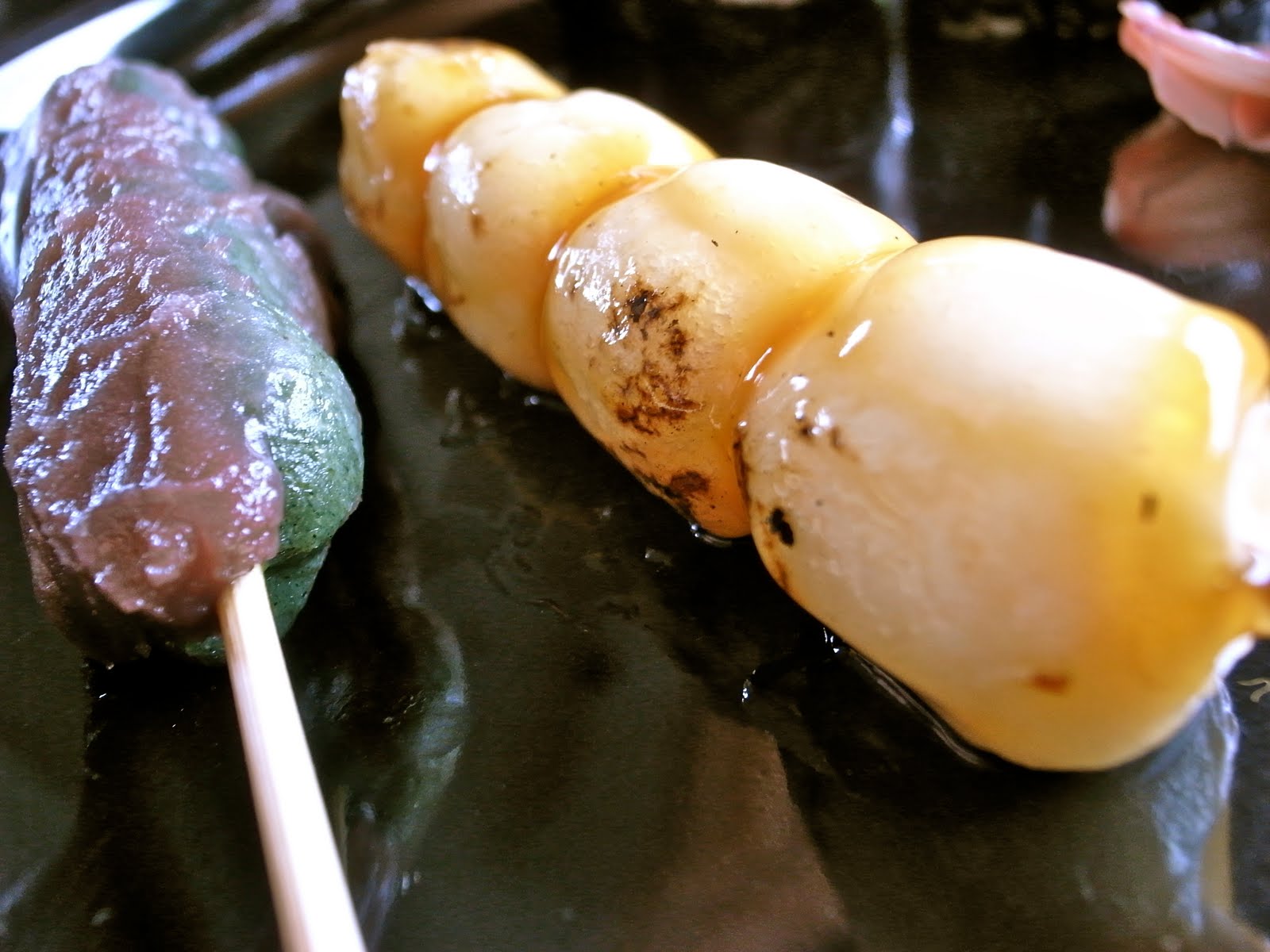
Among many sorts, I have first opted for the excellent salty-sweet "Mitarashi-Dango"(covered with a special starch-thickened sauce made of shoyu and sugar) which is quickly grilled before being glazed.
Second choice was the nicely-colored "An Dango" covered with Anko. The green color of the dango might be mistaken for green tea but it is rather coming from the Yomogi (mugwort) they mix with the rice flour. Yomogi is a herb that you won't come across often so for anyone interested, here's an article on that green. The Yomogi adds to the skewer an unbeatable freshness that will go very very well with any slightly bitter green tea or Hoji-cha (charcoal roasted green tea)

An-Dango (Left) Mitarashi-Dango (Right)

Oh, and Daifuku literally means Great Luck, so even if they're out of Ichigo-Daifuku, try their regular Anko ones to replenish yourself with some of that good fortune.

Iseya is open everyday from 09:00am to 19:00pm except on Wednesdays.
The shop is easy to find at about 200+m north from the West exit. Click here for a MAP
Setagaya-ku, Daita 6-5-23
03-3466-6731

Spicia (Indian), Shimokitazawa

If you're looking for a relatively cheap, really good Indian place, "Spicia" (Kitazawa 2-23-12, 03-3414-5055) is THE place to go. The chef used to work for the Taj Hotels in India, so we're talking about some serious culinary experience here. Not to mention the staff who are extremely polite and more than willing to help you with your menu choices, so feel free to ask them.

The sag curries are powerful in terms of spinach aroma and very pasty. Try the great Sag Mutton (above) with their garlic chip nan (below). Spicia has a great choice of Nans (plain, cheese, garlic, sesame, basilic) as well as a nice Masala Culcha (sort of vegi stuffed Nan). My favorite is the sesame nan. For amateur of mexican Quesadillas, the cheese Nan is a great alternative.

Tried yesterday for the first time the Keema Mattar curry (Minced lamb curry with peas) which was wonderful. Ask to make it slightly hotter. It was matching the sesame nan (below )perfectly.


No pictures here, but definitely order their soup.

They are open 7 days a week so enjoy!

It's a 30sec walk from the West Exit (on the Inokashira-line platform). Exit left, climb the stairs, take left and turn left immediately on the street parallel to the train. It'll be on your right after 50 metres
Setagayaku, Kitazawa 2-23-12
click here for a MAP