Showing posts with label south exit. Show all posts

Vi-Sand (Vietnamese), Shimokitazawa

My wife and I spent ten days in Vietnam last year and somehow never got to eat the popular baguette sandwich "Banh Mi" (here's your wiki article on the dish). It's really quite a shame as it's probably one of the very few good things French left in Indochina, and I had quite fantasized about the legendary baguette dish before leaving for Saigon.
We have never had the chance to try some of those places yet, so how happy were we when we realized that a Banh Mi joint had just opened in Shimokitazawa less than a month ago.

Vi-sand, which is an abbreviation of "Vietnamese Sandwich", is quite far your cliche asian joint and looks more like one of those relatively stylish new cafes popping out by the dozens in Tokyo right now. The place is managed by a friendly foreigner (he told me he's a restaurant producer) who is more than willing to help you: when I told him that this was our first Banh Mi ever, he kindly explained me what the dish was all about and what the recommendations were.

Definitely not looking like your average Vietnamese

There is a a choice of 4 Banh Mi: Beef & Lemongrass, Chicken & Ginger, Fish & Tomato and Tofu & Vegetables. My wife and I opted for the most popular "Beef & Lemongrass". By the way, each sandwich comes with a drink and a potato salad.

This is what the Lunch set looks like

I had always imagined Bahn Mi being made of crunchy French Baguette bread but the one we got served after 5 minutes following our order was definitely on the softer side. It has the obvious merit of not hurting your palate, but I would have preferred it crunchier.

The veggies

Once the surprise of the soft bread is left behind, the second impression is of a nice lemongrass aroma, which gives the dish a pleasant and refreshing taste. The freshness is accentuated by plenty of fresh coriander and mint leaves, some thinly-cut pickled radish and carrot, and some sweet and sour Nuoc Mam fish sauce.
The choice on the menu is mint or coriander but you can add either one for ¥50.

The meat hidden under the vegetables

The little strips of beef are stirred with minced ginger and what seemed to be on a blend of Nam Pla fish sauce and Shoyu soy sauce. They also add some pink-colored liver paste on the bread.
As mentioned earlier, the sandwich comes with a regular potato salad, but you can change that to a soup. The soup might actually be a better choice if you want to keep some sort of Vietnamese vibe to your food.

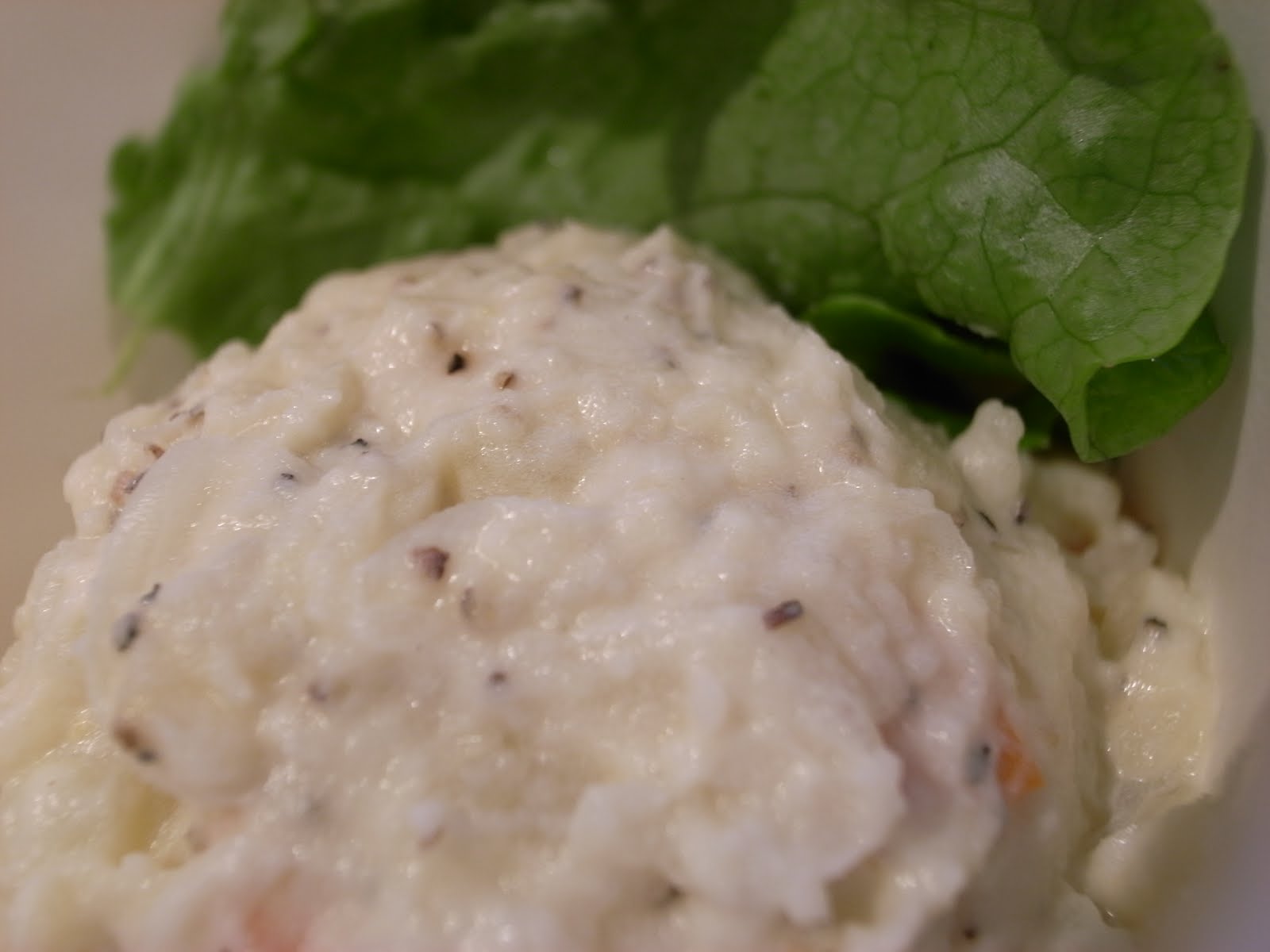
The not-so Vietnamese potato salad

It's overall a nice lunch though the pricing at ¥750 with a drink and a soup/salad might be very slightly high.
Once again, I have never tried any Bahn Mi before so I have no way of comparing it with other places, but if you have, your comments are welcome.

So there are no surprises when you come here, you should know that they don't serve Bahn Mis for dinner, if not for a Ham Bahm Mi (and some stews, curries and pots)

Vi-Sand is open everyday from 11:00am to 16:00pm for lunch and 18:00pm to 23:00pm for dinner.
2-12-13 Kitazawa, Setagaya-ku
03-6805-4624
Click here for a map

Nakamuraya @ WeST PArK CaFE (Ramen and Burger), Shimokitazawa

East Meets West

This has to be one of the weirdest combination of food I've seen in a while: Ramens and Burgers served in the same establishment. Then again, if these were served in a random restaurant, I'd be VERY suspicious about the outcome, but we're talking about a famous Ramen joint "Nakamuraya" and an expat favorite West Coast style restaurant "WeST PArK CaFE" collaborating, so it got my taste buds rather excited.
By the way, you should know that the owner of "Nakamuraya" (famous for its salt-based broth), Shigetoshi Nakamura, has spent some time in the US as a teenager and also opened in 2009 a Ramen joint in Los Angeles called "Ramen California". It should therefore come as no surprise if he has been interested in mixing genres and cultures again.

The stylish shop opened beginning of January and I can't say it's been drawing crowds yet. Does it need more word-of-mouth or is it just potential customers being dubious about the combination of cuisine served there? I'm not sure yet. All I can say is that the burger I ordered was pretty good, so chances are the bowl of Ramen is worth it too. But that'll be for another occasion.

Stylish interior

There are two chefs in the kitchen: one seems to be in charge of the Burger menu and the other one looks at the Ramen noodles. Though I've been to WeST PArk CaFE countless times, I've never tried their burgers, so I decided to have the former cook get to work by ordering the Bacon Cheese Burger. (For your information, every burger comes with some fries)

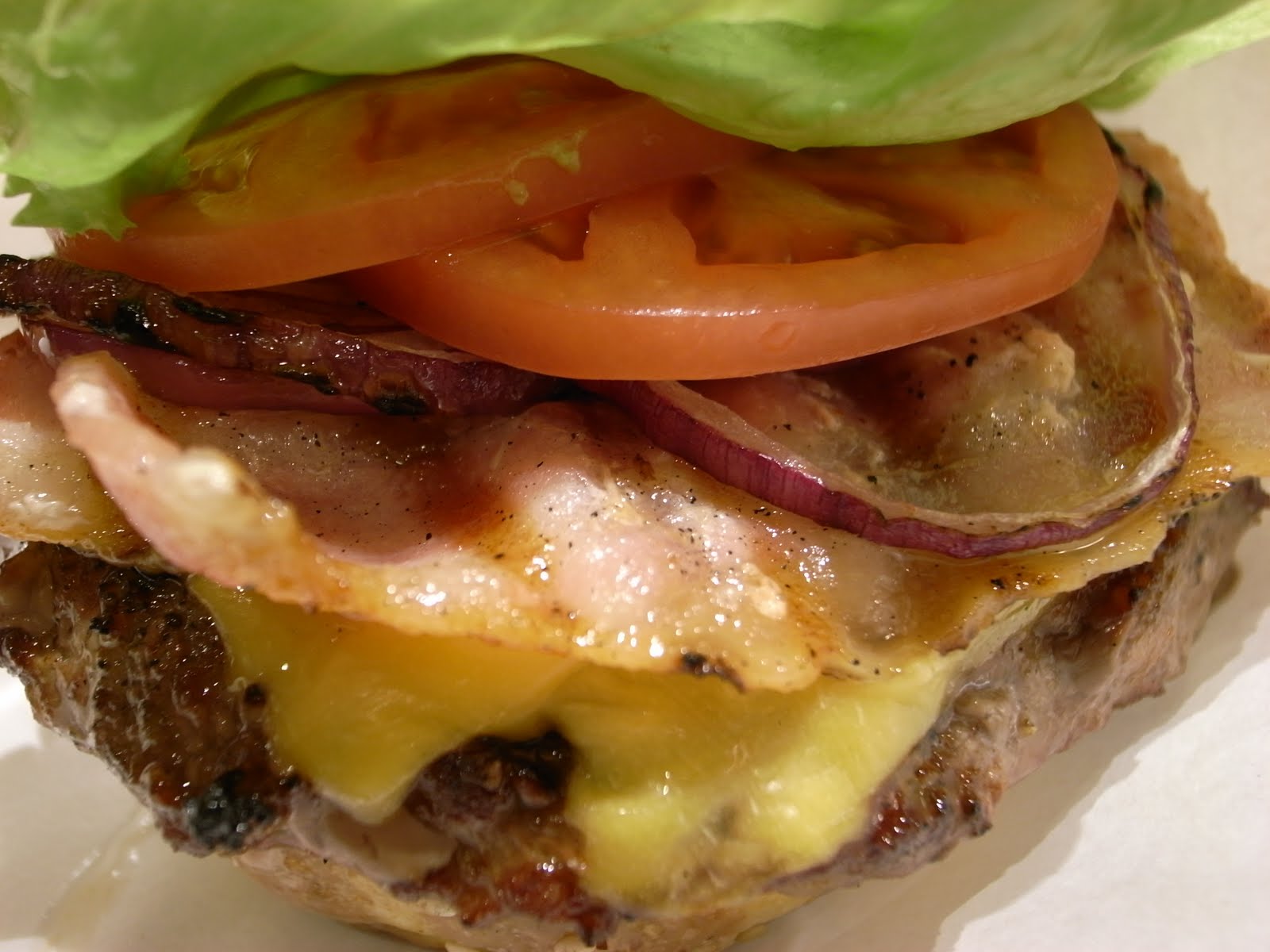
The Bacon Cheese Burger

In about ten minutes came a rather tall burger with a promising look. The pictures don't do the burger justice in terms of size and color, but I can guarantee you that from the fresh tomatoes, lettuce and grilled onions to the juice-dripping beef pate and melted cheddar cheese, everything was pretty mouth-watering. The white sesame-topped buns are quickly toasted over the grill and (if I remember well) a hint sweet. Good bread. As far as I know, WeST PArk CaFE bakes its own bread so I would assume the bread here is homemade as well.

The buns soaked in meat juice

The charcoal-grilled pate is made of 100% Australian beef and there are no eggs, bread crumbs neither onion mixed in the meat : just plain meat so you can appreciate its taste. The beef was good and juicy, seasoned with salt and pepper only. There was a little bit of mayo-like sauce on top of the lettuce, but that's the only seasoning I could find besides what I mentioned. If you're the type of person who likes his/her burger simple with as little sauce as possible, this place should suit your taste.

The long and sweet French fries

There were not a lot of French fries on the side, but the few ones on the plate were thick and a good 4 to 5 inches in length. They tasted a little bit like Japanese sweet potatoes, so it was slightly surprising at the beginning. Good nonetheless.

The Bacon Cheese Burger costs ¥1,400 so it's not the cheapest burger around but it was a satisfying dish, both size-wise and taste-wise. Will try to review the famous Ramen next time!
In the meantime, Bon Appetit!

Nakamuraya @ WeST PArK CaFE is open everyday from 11:30am to 23:00pm (L.O. 22:00pm)
03-3410-1120
Setagaya-ku, Daizawa 5-32-13
Click here for a MAP

Varie (Yoshoku), Shimokitazawa

After hearing that the uber-popular Japanese comedian Gekidan Hitori(劇団ひとり) would go to this Yoshoku joint "Varie" when he wants to treat himself, my wife and I got curious and decided to try it. If you don't know what Yoshoku is, here's a little explanation I wrote on a previous post:

A quick recap for anyone not familiar with Yoshoku. This Japanese remix of so-called western cuisine is said to have appeared during the Meiji Period, when Japan opened to and started to embrace the European civilization as a mean to develop the country. Though most of the dishes are European recipes adapted to the Japanese palate and available local ingredients, some dishes like Omu-Raisu (ketchup flavored rice stuffed omelette) or Chicken Rice (not to mix up with the Hainanese Chicken Rice or the Arroz Con Pollo in Latin America) are somehow "originals".

What Gekidan Hitori craves for is the Katsu Kare (curry and rice with a piece of deep-fried pork cutlet), but I went for the chef's recommendation Beef Stew to start with, while my wife opted for the "Yoshoku classic" Hanbagu Suteki (Hamburger steak).

We were quickly given a rather lukewarm onion soup and a little salad as part of the lunch set. Both dishes are nothing to remember of, so I'll pass on the details.

The star of the day came to me a little lukewarm too, but that may have to do with me spending too much time trying several setting for the best pictures. As you can see, the stew comes with your typical "English" style boiled vegetables, though I think the carrots were buttered and the potatoes quickly sauteed. Same as the salad and the soup, the supporting roles did not change my life.

The beef is very well stewed while leaving a little resistance to the teeth : not quite the literally melting-in-your mouth, disintegrating one, but almost there. The meet is not annoyingly fibrous as it can sometimes be so it's definitely a pleasant eat. The sauce is the typical red-wine based glaze, a hint dense but pretty good, and doing wonders with the rice (served on a different place). There seems to be, as you can see from both pictures, quite some fresh cream added before serving.

Not bad overall, but it costs ¥1,500, and when the hamburger steak my wife ordered cost only ¥800, it suddenly felt quite expensive for what it is. According to her, the steak was good but nothing extraordinary.

Which brings me to an early conclusion: maybe we should have gone with Gekidan Hitori's recommendation in the first place, the Katsu Kare. For your reference, I have featured two of the said dish in the past so please have a look should you be curious: the curry shop Pannya and the old-school Yoshoku eatery Kitchen Nankai

Varie is closed on Thursdays and opened the rest of the week from 11:00am to 14:30pm for lunch and 17:00pm to 22:00pm for dinner.
03-3419-0865
2-29-12 Daizawa, Setagaya-ku
Click here for a MAP

Dashin Soan (Soba), Shimokitazawa

the charming entrance

Finally some time to add a new entry!

This new post in a while features Dashin-Soan, an establishment serving a typically Japanese item: the cold "Soba" (noodles made of buckwheat flour) . But not your average soba you'll find for ¥300 at cheap eateries in stations or chains... The "superior" quality one.

the "waiting" space with the garden in the back

To be honest, I don't care that much about sobas as I am much more of an Udon guy (thicker noodles made of regular wheat flour), but I definitely like this place. I haven't been there a lot as it is a little out of the way (a good 15mn walk from the station), but the traditional decor and garden around the restaurant creates a soothing Japanesque ambiance and the noodles have been excellent every time we've visited the place. Not to mention the Shinganji temple right across the street with its giant gingko tree and a locally very popular shrine, the Kitazawa Hachimangu a block away, so the post-lunch/dinner promenade is worth it.
Dashin Soan is very popular, so you might have to wait a little bit before being seated, but the wait is on a bench outside by the garden, so it's not stressful at all.

everything is nice and classy

We waited about 10mn before being welcomed in the elegant restaurant: everything from the furniture to the dishes is chosen with taste.

In order to fully enjoy the noodles' flavor, my wife and I both ordered their recommended Akisoba (Autumn Soba) noodles, freshly boiled then washed and chilled in cold water, and eaten dipped in a cold dark brown Tsuyu broth (a mix of dashi, mirin and shoyu).
Akisoba designates the Sobas made of buckwheat planted between early June and mid-September and harvested between late August and late December.
Dashin Soan's noodles are totally homemade, from shelling and grounding the wheat, to making the dough and thinly slicing it into fresh noodles.

the supersized noodles

The noodles come in a large plate with two holes in the middle (that you don't see on the picture) that act as drainers for the excess water. Freshly grounded Wasabi and thinly-cut Negi (Spring onion) are served on the side for your liking. Japanese usually add both in the broth.

The grey noodles are square, about 2mm in width and a hint brown because of the tiny bits of grounded buckwheat shell mixed in the flour. The Koshi (firmness) is quite strong and the bite al dente. We ordered the supersize, which did not seem to be a lot at first but it's actually filling: you'll see... just don't slurp and swallow. Chew and savor those, and you'll find yourself really full. Plus, that will let you fully enjoy the taste of the buckwheat, slightly reminiscent of the wonderful aroma of a rustic Pain De Campagne country bread.

the freshly boiled and then cold water chilled noodles

At ¥1,300, it is not a very cheap lunch, but everything from the decor to the noodles is upscale, and you should thoroughly enjoy the experience.

Last but not the least, if you want to eat the noodles the real Japanese way, you should order one or two little entrees to munch on with some nice sake and finish your nice meal with a plate of noodles.

Dashin Soan is closed on Tuesdays, open the rest of the weekdays from 11:30am to 15:00pm and 17:30pm to 21:30pm; from 11:30am to 21:30pm on weekends and notional holidays
03-5431-0141
3-7-14 Daizawa, Setagaya-Ku
Click here for a MAP

Gyoza Senmonten Genbu (Gyoza/Noodles), Shimokitazawa

Chinese dumpling "Gyoza"s are often side dishes in Japan. People order them in Chinese joint as part of a bigger menu, paired with Ramen noodles or Chahan (Fried rice) for example, and rarely as a solo item. The trend has recently changed though, and restaurants specialized in Gyozas have lately increased. Gyoza Senmonten Genbu (Specialized Gyoza restaurant "Genbu") which opened in the summer of 2007 is one of them, and though seemingly going through high and lows in terms of occupancy, has established itself as a moderate player within the Shimokitazawa food business.

If you're wondering what Japanese-style fried Gyoza are, please click this wiki article on the dish. Should you want to skip on it, you just need to know that it's ground meat (most of the time pork) mixed with finely chopped vegetables (generally garlic, chinese cabbage and Nira garlic chives) wrapped and sealed in thin dough before being fried. I have also talked a little bit about the history of the dumpling in Japan and the not-so famous reason why Japanese added garlic in the Chinese recipe, in this post.

Genbu doesn't really look like a normal "Chinese" restaurants: most of the apparent infrastructures are in metal (even the stools are what seem like kegs with a cushion on top) and a big tv monitor near the kitchen plays MTVish R&B music, therefore giving the place a rather cluby look, uncommon in this neighborhood. However, don't let that modern western feel deceive you on the food quality: they do serve very decent dumplings and (less memorable) noodles.

I went for the house-speciality "TonToro Gyoza", which adds some gourmet pork cheek meat in its regular pate. The cheek is supposed to be one of the most tender part in the animal and butchers can only get a little amount from each pig so it is a "limited" menu, slightly more expensive than the more standard dumplings they also offer.

The gyozas were very well fried, the dough being nicely crunchy (but not hard) and golden-brown on one side whereas the other "rawer" faces offered more doughy resistance. Some bad places will sometimes offer you fried dumplings that have the same texture all around and that can be such a turn-off... The ground meat felt very tender indeed and the first bite freed a bit of some nice juice from the sealed dumpling. The amount of garlic felt just fine and balanced and the overall taste pleasant. The shop takes pride in recommending you to eat its Gyoza with lemon juice, salt and paper, and not with the orthodox soy-sauce/vinegar/chili oil mix, so you can enjoy the taste of the meat better. I can definitely recommend you to follow their advice. Good stuff.

A plate of Gyoza not being enough to fill my belly, I also ordered a Nira Ramen (Ramen topped with chopped Nira garlic chives), a dish that I have learned to appreciate at the excellent Chinese restaurant "Fuumin" in Omotesando. The waiter warned me that it is a hot and spicy noodle dish, but I ignored his tip and still went with it as the one I was used to in Fuumin is a delicate one based on a low-salt bouillon.
Well, stupid me: it was hot! Not the unbearable hot, but still enough to cleanse your system the next day...If you don't like hot, don't even think about trying this. The soup was so red-hot with Rayu (Chinese style chili-infused vegetable oil) and thus so chili spicy that I couldn't really tell what the broth was based on. There was a moderate topping of what I thought to be a mix of pork ground meat with a sesame oil based sauce, that smoothed the taste when mixed with the soup, but it still was not enough to clear the hotness.
The noodles used were interesting as they had the very characteristically firm texture, almost the color, the size and the taste (not too sure about the taste as it was lost in the chili aroma) of the noodles used in the Korean-style cold Reimen noodles. It is rather rare to have these used in hot noodles recipe so that's worth the experience.

At ¥500 the beer, ¥450 the Gyoza and ¥750 the noodle dish, this simple dinner amounted to ¥1,700, which is affordable. Their beer is nice and cool, so if you feel like munching on heaps of Gyozas while downing some draught beer, Genbu is definitely an affordable option. The waiters are polite and very professional.

By the way, it's next door to the uber-famous old-school Chinese eatery "Mintei".
And if you're into J-Pop, it's worth noting that the restaurant is owned by someone very close to the multi-platinum selling duo "Kobukuro". Who knows, they might come one day for a plate of Gyoza?

Genbu is open everyday from 11:30am to 04:00am
03-3481-5655
Setagaya-ku, Kitazawa 2-8-8
Click here for a MAP

Magic Spice (Soup Curry), Shimokitazawa

I am featuring today probably one of the most famous soup curry restaurant in Tokyo, "Magic Spice". For those of you not familiar with this tasty and spicy dish, let me copy and paste that little paragraph I wrote before in this other soup curry joint "Kokoro" feature post:

The Soup Curry was born in Sapporo, in the Northern Island of Hokkaido, where it's become as popular as the Ramen, with more than 200 restaurants all competing for the best of its genre. The trend has gone southward and you can find Soup Curry restaurant all over Japan now.
This Japanese remix of the Indian curry is exactly like its name describes it, that is a soupy one. Each restaurant takes pride in cooking the perfect bouillon in which they'll add the spices and the ingredients that they will slowly stew, for the perfect soupy curry
.

Bollywood on steroids interior

Magic Spice actually happens to be slightly misunderstood as they're serving more of an Indonesian chicken soup "Soto Ayan" with strong curry flavor rather than a standard soup curry. The mistake by customers is easily understandable though, as the decor inside and outside is of a completely pseudo-Indian psychedelic taste, and even the waitresses dress like they could be working for Air India. The top page of the "English" website is probably the only place with a little bit of Indonesian graphics.

The extravagant look aside, the menu ordering system works a little bit like the "Kokoro" one, meaning you first need to choose the soup dish you want (chicken, pork, beef, seafood, vegi and so forth) and then you ask for how spicy you want it to be. All you need to know is that even the smoothest one is relatively hot, so you shouldn't challenge yourself unless you really can stand it, and the spicier it is the more expensive it is, so it is generally a wise choice to keep it edible at a smooth level.

There are 7 levels of hotness, all named after pseudo-buddhism references, which are (in smoothest +¥60 to hottest order +¥250) :
覚醒 (Kakusei or awakening) > 瞑想 (Meisou or Meditation) > 悶絶 (Monzetsu or Faint in agony) > 涅槃(Nehan or Nirvana) > 極楽(Gokuraku or Heaven) > 天空(Tenkuu or Vault of heaven) >虚空(Kokuu or Void)
There is also an astronomical level of hotness which is not on the menu but which you can ask for, called アクエリアス (Aquarius). You have to sign a waver (I'm serious...) when eating this so do it at your own risks!
Talking about pseudo-buddhism references, you will see that this place is full of weird buddhist and hindi graphics, very strange texts all over the place (from your table to the walls) about how eating curry and enjoying strong spices will make you trip etc...

I ordered the "World's best, tender and juicy" Chicken leg soup curry, and cautiously went for Meditation (Level 2) to start with.

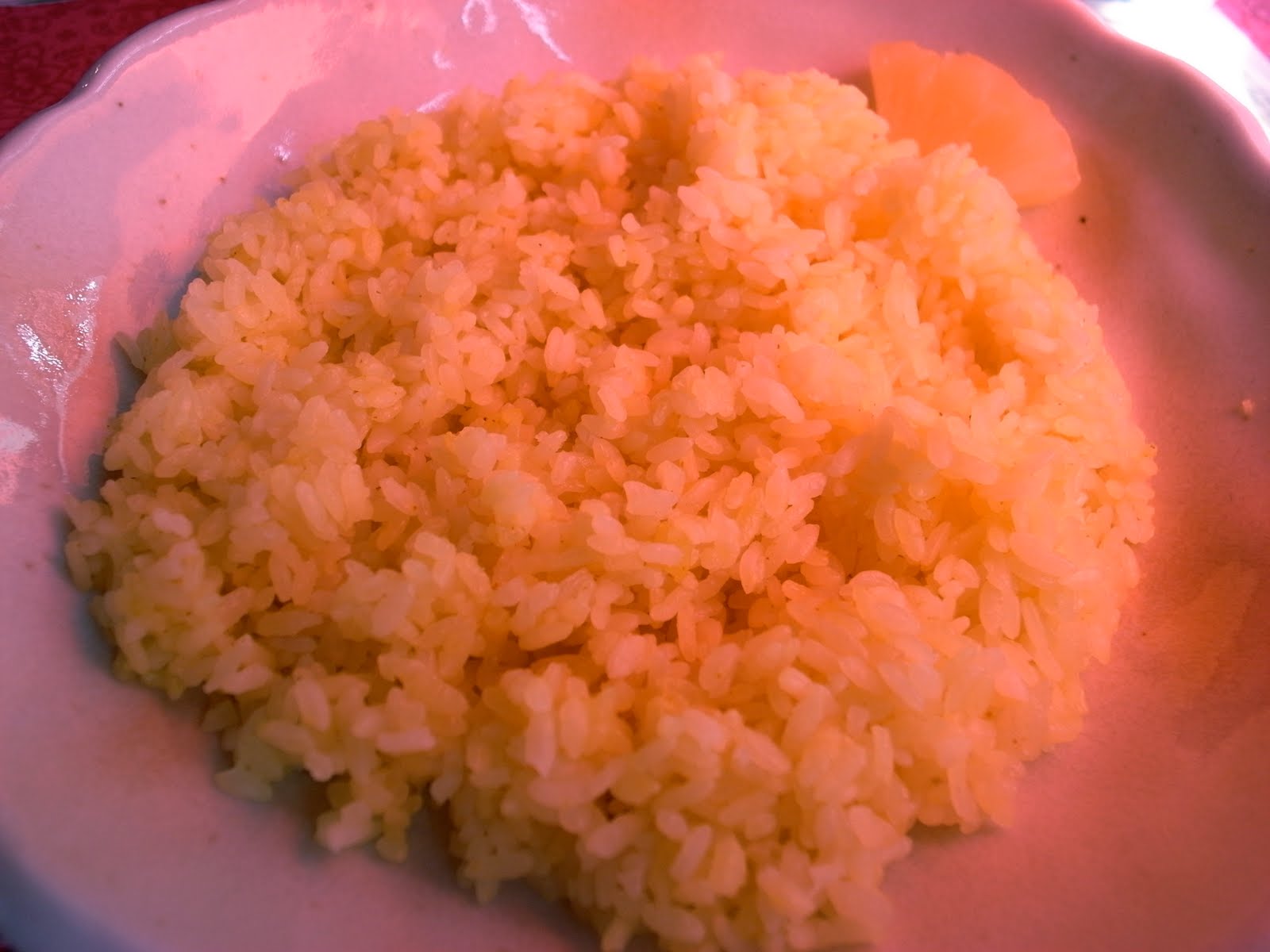
After 10 minutes came a plate of safran rice (with a slice of pineapple) and a pretty big soup with a big chicken leg in it. The other ingredients were some cut carrots, Daikon radish, cauliflowers, onions and chinese cabbage.

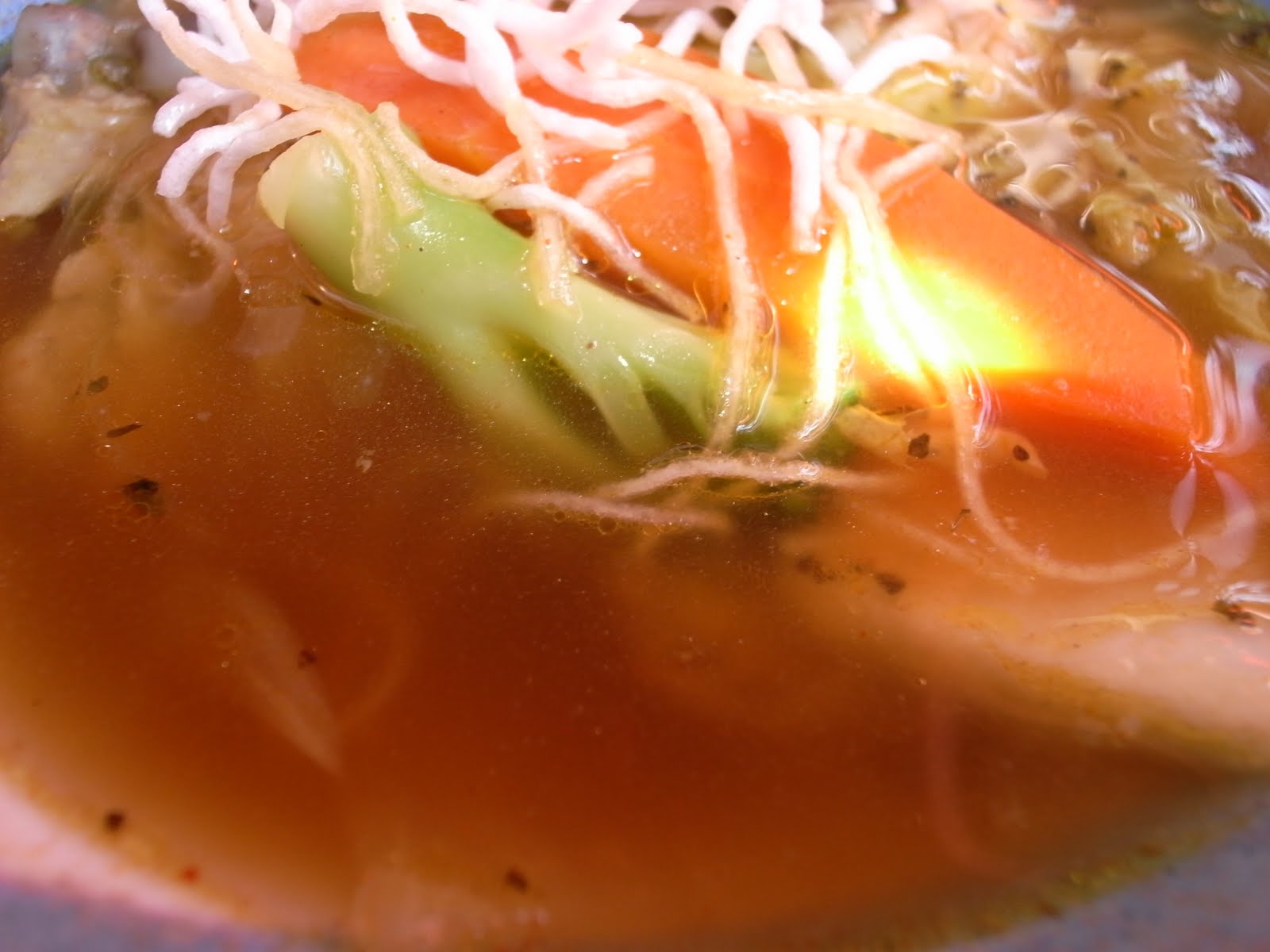
Chicken curry and a ray of light

As I told you before, the soup curry here tastes more like a soup with curry flavor. To be more precise, it tastes like a good Pot-Au-Feu, that is a stewed bouillon of chicken and vegetables, with some added "indian" spices like garam masala and some more pepper. The first spoon is surprising as although you know you ordered Level 2 hotness, the spice kick is rather impressive. That's where the safran rice comes in timely and handy as it helps you escape from the peppery feeling.

The mouth-saving safran rice

In case you'd like to smooth or spice-up your soup, there are some red-hot chili powder, some galam masara like yellow curry powder and a transparent liquid made of lemon, lime juice diluted in water. I tried the citrus water which does wonder in smoothing the broth.

Chili powder, curry powder and the magic water

The chicken is well stewed and you really don't need to work hard on it to detach the tasty flesh from the bone. I also prefer the skin roasted than boiled, but it is cooked here long enough to feel unobnoxious. The size of the specimen is quite big so if you're a chicken eater, that one leg should be enough to please you.

As you can see, it looks more like a Pot-au-feu than a curry...

Once again, this is not what I would call a soup curry, but Magic Spice is very very popular in its own right (you will probably have to wait before getting to a table), so should you be curious about the decor, the various mystical levels of hotness and the reason why its cuisine is so famous, please give it a try yourself!

Magic Spice is closed on Tuesdays and Wednesdays, open from 11:30am to 15:00pm and 17:30pm to 23:00pm the rest of the weekdays, and from 11:30am to 23:00pm on weekends and national holidays
03-5454-8801
Setagaya-ku, Kitazawa 1-40-15
Click here for a MAP

Marusan Foods (Japanese style cafe/restaurant), Shimokitazawa

Today's feature is one of those "I've lost track because there are too many of them" funky eateries of cool Shimokitazawa. Marusan Foods (the restaurant logo is a circle or "Maru" with number 3 inside or "San", hence the name) serves lunch, acts like a cafe in the afternoon, and from what I heard provides aficionados with good and healthy dinner fares in the evening.

the several jars of fruits marinating in vinegar

I climbed up the stairs to the third floor, got there at noon sharp for the opening and there was no customer around until I was finished, so lucky me for the relaxing lunching experience. The only problem was that their A/C wasn't working, so on a 35C heat day, that may explain why I was the only fool sweating in there.
The music playing was a series of Walter Wanderlay-ish loungy keyboard music so the heat and the music made for an out-of-place Copacabana atmosphere.

The food is far from being Brazilian though, if not for the green and yellow color of their specialty dish Omu-Raisu (stirred rice stuffed omelette), reminiscent of the Brazilian flag.
Yes, you heard me right: their Omu-Raisu is green and yellow, when it should be and has always been yellow and red, that is the color of the omelette and the ketchup-based sauce on top. This is the first time I have EVER seen such anomaly and I believe Marusan is the only place in Japan which serves a green Omu-Raisu.

Jako-Sansho-Gohan Omu-Raisu

The green sauce is actually a green peas sauce that is flavorful enough to remind me of those peas potages they serve in French cuisine. Very good stuff, but it unfortunately blends so well with the rest of the dish that you don't really feel the peas at all.

The quickly sauteed rice beneath the excellent and runny omelette is very low on salt, mixed with fried Jako (very small dried baby sardines) and very aromatic wholegrain Chinese pepper "Sansho". The bomb of flavor and the numbness to the tongue that this spice brings continues to amaze me. So it's actually maybe without surprise that the peas seem so reserved when the rest of the ingredients are so flavorful.

A Sansho pepper on the left and a white Jako (can you see it? It looks like a long rice grain)

Overall a well-balanced and excellent dish. I still doubt the efficiency in taste of the peas, but the color they bring is WAY WORTH IT!

My ¥890 set came with an excellent and pungent Aka-Dashi Miso Soup (made of regular "Mame-Miso" fermented bean paste and "Kome-Miso" fermented rice and bean paste; you will often come across this soup in Sushi restaurants), some Tsukemono marinated pickles and the delicious grey-brown paste on the above picture which tasted like a Goma-Dofu (Sesame Tofu). If it was indeed what I reckoned it was, then it is a dish consisting of black sesame seeds, water and Kudzu powder. If not for the very little Katsuo-Bushi (dry bonito shavings) that was topped on the paste, it would have been the perfect Buddhist vegan Shojin recipe.

After a satisfying meal (despite the brutal heat), I had to have something refreshing so I chose from one of the many curiosity-enhancing "vinegar-marinated fruits drinks" they offer the "Marinated fig in milk" drink (for an additional ¥300). As you can see from the very top picture of this post, they have a dozen of different fruits marinated in vinegar which you can mix with Soda, Milk, Soy milk or some final liquid I can't remember anymore.
I thought the combination would be too weird, surely undrinkable or at least way too sour, but my mix actually tasted like a very nice slightly sour Fig Lassi (if that can give you an idea). I'm not sure I would drink gulps of it, but I thought it acted as a perfect dessert to finish the overall very satisfying lunch.

I definitely recommend this place for lunch (I haven't tried the dinner yet). The staff is nice, the food is good and affordable, the location is charming; so provided the A/C is back by the time you visit the place, you should thoroughly enjoy it.

Marusan Foods is open everyday from noon to midnight, and until 02am on Saturday nights
Setagaya-ku, Kitazawa 2-8-5, 3F
03-3485-3838
Click here for a MAP

Nasu Oyaji (Curry), Shimokitazawa

sign

I was walking the other day on the south side of Shimokitazawa when a tiny sign at the entrance of a little street caught my eyes, advertizing a restaurant located "63 steps" from there. Pushed by curiosity and hunger, I started walking towards the mysterious joint carefully counting my steps until I got there after 59 steps (have you ever wondered why your steps seem to become suddenly smaller when you count them?).

The cute shop I got to is "Nasu Oyaji" (probably best translated as "Uncle Eggplant"), a curry shop that's been exactly 20 years in business, with a very limited menu of about four different curries. The interior is wood based, rather charming and looks like one of those numerous cafes in Shimokitazawa, simple and arranged with good and humble taste. You can see on the righthand side of the picture a rack with a hundred or so vinyl records which the Eggplant Man plays as a nice background music. Some old american pop was playing when I was there and it does seem like music is one of the boss' passion. It looks like the place is patronized by a lot of musicians as well as music industry people, and there were two guys sitting at a table that clearly were from the biz.

interior

As I said earlier, the food choice being limited, it wasn't too hard to make a decision between the Chicken, Beef, Vegetable or All-mix curries: loving vegies for their taste and for the inner peace they give me when confronted to the gargantuan amount of food I usually ingest, I quickly opted for the Yasai Kare (vegetable curry).

After my order, I started reading a couple of news items on my phone and stepped outside the building to check-in on Foursquare when the waitress got out to tell me the dish was ready. That's how fast I was served.

Vegetable Curry

The regular serving of curry and rice is larger than an average portion somewhere else and should be enough provided you're not starving. The ingredients topped were cuts of boiled eggplants, carrots, broccolis, mushrooms and a quarter of fresh tomato. The boiled egg you see in the middle is a topping I added for ¥50.
I have recently been eating a lot of eggplants that were quickly fried before being additionally cooked so the simply boiled eggplant felt a little "British" and watery but that's basically my only complain.

The curry was hotter than I thought, and probably too spicy for anyone disliking hot stuff. It tastes like a crossbreed of old-school Japanese Kare and authentic Indian curry, with the former one being dominant. The not-too-pasty sauce has this undeniable sweet aroma characteristic of the curries your Japanese mum cooks but with a hot accent of pepper.
The boiled egg was a good idea as the yolk smoothens the curry to a really nice degree when and where mixed. Recommended.

I am attaching for your information a paragraph about addiction from the Wiki article on Curry which I found interesting as I had no clue there were talks of dependance on it.
---------------------------------------------------

Curry addiction

A number of studies have claimed that the reaction of pain receptors to the hotter ingredients in curries, even korma, leads to the body's release of endorphins and, with the complex sensory reaction to the variety of spices and flavours, a natural high is achieved that causes subsequent cravings, often followed by a desire to move on to hotter curries. Some refer to this as addiction, but other researchers contest the use of the word "addiction" in this instance.[28]

---------------------------------------------------

Nasu Oyaji offers rather basic curries but I somehow understand that some people get addicted to the place and its dishes. A simple menu with good food that's not too expensive in a nice cafe-like atmosphere, that's probably the secret to two decades of successful business in an ever changing and competitive environment that is Shimokitazawa.
They're also serving curries all afternoon, so if you feel a little hungry around 4pm, it is definitely an option!


Nasu Oyaji is closed on Thursdays and serving curries the rest of the week from noon to 22:00pm (L.O. 21:30). They do close when out of sauce, so good luck!
03-3411-7035
Setagaya-ku, Daizawa 5-36-8
Click here for a MAP

Com Pho (Vietnamese), Shimokitazawa

I'd like to feature today this Vietnamese restaurant which we used to patronize quite frequently five years ago or so, "Com Pho". We stopped going there when we felt like somehow the great food quality had gone down (and I believe the cooks had changed) and because of an appetite inhibiting bathroom odor that used to float in the air and which was getting stronger and stronger at the time.

So we hadn't been paying much attention to the restaurant for years until we recently saw a sign outside the restaurant advertising its "Tom Yam Kung Pho". I am a HUGE FAN of the Tom Yam Kung Ramen at Tinun Shibuya so I got tempted, knowing how exciting it would be to discover closer to home the Vietnamese remix of the dish.

You can imagine how quickly I gave my nostrils the odor test when entering the classy restaurant. This is by the way one thing that has not changed from the beginning: the decoration has always been quite upscale for a Vietnamese in Shimokitazawa. There still subsists a suspect smell but I couldn't tell whether it came from the condiments used in the kitchen or from you know where...

We sat down and (in spite of all the prior fantasy over the Tom Yam Kung noodle) ended up ordering the Pho Ga (Chicken Pho) which we thought was a better approach to knowing whether they had a decent cook or not, just like you should always order the Tamago (sweet egg omelette) in a Sushi joint to have a better idea on the house abilities.

In case you're not aware of what Pho is, here's your wiki article for a basic notion.

Quickly after ordering, the waitress put a dish of Moyashi (bean sprout) in front of us, which you can help yourself from as a free topping on your Pho. Too bad Com Pho doesn't also bring you all those herbs and leaves you can top on your dish, like they do in Vietnam.

The bowl that got to us was rather large and smelling good. I have to say that the first aroma didn't come close to what we had in Vietnam, but it was still a good reminder of what we had in that incredible country (should you be interested, here is a photo collection of our trip there).

The preset toppings were boiled chicken, chopped leek, long cuts of Nira garlic chives and bean sprouts.
The soup was pretty basic and tasted a bit too strong in what I think was chicken bouillon so I added lemon juice to smoothen it and a lot of hot chili sauce to add a kick to it.

As you can see, the rice noodles Pho are flat and their tenderness (I probably let them in the soup too long, busy that I was taking pictures) combined well with the soup. I supersized them for ¥100 and it was just enough for my hungry stomach so please do so if you think you can handle it no problem.

So, it's definitely not like what we ate in south-east Asia, but for ¥830 (when supersized) I think this makes for a very decent lunch when you're tired of eating Japanese food or simply want something slightly exotic.

They also have a rather extensive menu for dinner that's not expensive, so please give it a try and let me know how it was! In the meantime, I will definitely try the Tom Yam Kung Pho...

Com Pho is open everyday from noon to midnight (L.O. at 22:30)
Setagaya-ku, Kitazawa 2-13-4
03-5481-0564
Click here for a MAP

Hachibunme (Izakaya), Shimokitazawa

This Japanese restaurant, which celebrated its 10th anniversary in April is probably the most closely associated to our lives in Shimokitazawa, as we started going there around their opening right before we moved to this neighborhood, and continued using it almost like a canteen way after we settled in.

Hachibunme is owned by Jackpot, a catering company I mentioned before in the posts about "Tom's Kitchen" and "La Befana", managing about 15 restaurants in Tokyo, mostly in Shimokitazawa. You will recognize its restaurants by the wooden board outside saying "やってます" (We're open). Except for an improbable exception, you are almost guaranteed great service and good cost performance if you ever visit one of their businesses.

Hachibunme's manager since the opening is Shoji-San, an always smily, happy-going man who's always 120% about what he does, mainly trying to make you feel as welcome as possible. He is a football aficionado who will be very happy if you start talking about the Beautiful Game in general and probably stoked if you mention the Joga Bonito.

Hachibunme's characteristic resides in the fact that although they're a pretty basic Izakaya (Japanese style food serving pub), they have a very decent wheat-flour noodle Udon menu to choose from. I suggest that whenever you visit them, you leave yourself a little space for a bowl of noodle at the end. By the way Hachibunme means 80%, and is often used as part of the very wise expression ~Hara-Hachibunme (eat until you're 80% full)~ .

On our last visit, we started by ordering the "Taberu Rayu" (the "solid" Chinese-style chili infused vegetable oil), a condiment that has been one of the biggest food hits nationwide in 2010. This seasoning or appetizer (depending on what you want to do with it) is Rayu mixed with chopped garlic and crushed almonds. You can add that on pretty much anything, tofu, rice, noodles for an easy Chinese Sichuan-style dish. We just nibbled on it with our beers, though I do not recommend it for non Japanese beers. We had Bass Pale Ale and it did NOT go well with the it. "Saltier" Japanese beers should be good.

Next came our favorite Okinawa dish "Goya Champuru" (stirred bitter Gourd). Goya is a vegetable indigenous to the sub-tropical southern islands of Okinawa and is known for its very bitter taste and crunchy texture. The Okinawa people cook the gourd by saute it with tofu, pork, scrambled eggs before topping generous amounts of KatsuoBushi (dry Bonito shavings) and it's always a great recipe difficult to screw up. The one in Hachibunme is slightly salty but plentily satisfying.

Before attacking the noodles, we had the tasty calorie bomb "Sasami no Cheese Age Wasabi-Iri" (deep-fried chicken breast with cheese and wasabi). As you can see from the picture, it's big pieces of juicy white chicken breast meat stuffed with cheese and chopped fresh wasabi leaves, battered and then deep-fried. The cheese gets to you completely melted, and the combination with the batter is a complete sin. The cuts are relatively lower on salt than what you might expect or imagine so feel free to add a little salt that's served on the side of the dish.

My last dish was a large serving of nice KamaAge Udon, wholewheat noodles served in a hotpot with steaming hot water and hot Tsuyu dipping sauce. The noodles are served in a traditional large wooden box from which you help yourself, before dipping them in the dark brown Tsuyu broth in which you can add chopped leek or grated ginger to your likings.
As per the below movie, the noodles come to you quite hot and it's a pleasure to see the steam coming out of the miniature Hinoki bathtub like box. However, the hot water keeps on cooking the noodles so just quickly devour them, as they lose their Koshi (firmness) fast. Be cautious when helping yourself, as the Udon are slippery and you might splash everyone at your table when they escape from your chopsticks.


My wife had a really good bowl of GomaKara Reimen (cold noodles in a sesame and chili sauce), which is definitely an option if you want something more chewy and less Japanese than the Udon. The slightly spicy sauce is a Korean style one which you will probably like if you're into that cuisine. The cold noodles are VERY al dente so if you ever order them, you are on for an extensive jaw exercise.

Those four mains and a couple of British beers cost us ¥4,580 so it's quite nice at little over ¥2,000 per head, isn't it?

The restaurant is pretty big and even has a large tatami room at the back so they can handle quite some people. Even if they are full when you get there, which might happen sometimes as they're pretty popular, you shouldn't have to wait too long.

Hachibunme is open everyday from 17:00pm to midnight (L.O. at 23:00pm) and start from 16:00pm on Sundays and National holidays
03-3467-7412 ( or free dial 0066-9673-28949 for reservations only)
Setagaya-ku, Kitazawa 2-4-10
Click here for a MAP

Rishin (Ramen), Shimokitazawa

I tried the other day this new ramen joint which opened last March next to the nice Izakaya (food serving japanese style pub) "Zakoya". "Rishin" is the offspring of the Ramen shop "Kunishin" in the northern Nagano prefecture, and the name of the restaurant comes from the owner's daughter name (which contains the chinese character 莉 "ri").
The place looks nice, japonesque, and rather classy for a noodle joint with its black wood structure inside and outside the building. They do serve drinks as well, making it a ramen meets izakaya hybrid eatery.

I went for their recommendation "Negi Chashu Men" (ramen topped with leek and chinese-style bbq pork) which I supersized for free, as they let you
a) supersize the noodles or
b) have a bowl of rice or
c) have a bowl of rice topped with Tororo (grated Japanese Yam potato)
with no charge.

The big bowl that got to me was rather impressive in size and the first thought was that they're quite generous on both the white leek and the pork.

The soup is light brown, quite dense and salty with a thin layer of lard floating on the surface (not as much but a little bit like the famous chain Kazuki). I assume it is a Shoyu and Torigara (chicken carcass) based broth: not bad, except that the pork is very salty, so if you don't have a glass of water to wash it down, you're on for an intense NaCl experience.
The pork, though too pungent, has a very nice texture, keeping a good balance between the firmer flesh and the tender fat. Really too bad it felt so salty.

The mountain of thinly chopped white leek is seasoned with Rayu (chili infused Chinese style vegetable oil), the whole thing combining really well with the noodles and the soup. Just make sure you don't have any meeting or date on the same day as you're guaranteed to knock out your precious interlocutor with your breath.

The squiggly noodles are about 3mm wide, slightly flat and with a medium firmness. I think they go well with the dish, but a hint more koshi (firmness) might add a little more character to the dish. I'll be fair to the shop though: I did spend some time tasting the pork and the leek before I attacked the noodles, so maybe they got softer during that time.

They do have other recommended noodle dishes as well, so if you're interested, please give it a try. The ramen I had was so-so: I found the whole thing too salty and dense, but might be good if you're into pungent broths!


Rishin is open everyday from 11:30am to 15:00pm and 19:00pm to 01:00am
03-3466-0398
Setagaya-ku, Kitazawa 2-9-21
Click here for a MAP