Rishin (Ramen), Shimokitazawa

I tried the other day this new ramen joint which opened last March next to the nice Izakaya (food serving japanese style pub) "Zakoya". "Rishin" is the offspring of the Ramen shop "Kunishin" in the northern Nagano prefecture, and the name of the restaurant comes from the owner's daughter name (which contains the chinese character 莉 "ri").
The place looks nice, japonesque, and rather classy for a noodle joint with its black wood structure inside and outside the building. They do serve drinks as well, making it a ramen meets izakaya hybrid eatery.

I went for their recommendation "Negi Chashu Men" (ramen topped with leek and chinese-style bbq pork) which I supersized for free, as they let you
a) supersize the noodles or
b) have a bowl of rice or
c) have a bowl of rice topped with Tororo (grated Japanese Yam potato)
with no charge.

The big bowl that got to me was rather impressive in size and the first thought was that they're quite generous on both the white leek and the pork.

The soup is light brown, quite dense and salty with a thin layer of lard floating on the surface (not as much but a little bit like the famous chain Kazuki). I assume it is a Shoyu and Torigara (chicken carcass) based broth: not bad, except that the pork is very salty, so if you don't have a glass of water to wash it down, you're on for an intense NaCl experience.
The pork, though too pungent, has a very nice texture, keeping a good balance between the firmer flesh and the tender fat. Really too bad it felt so salty.

The mountain of thinly chopped white leek is seasoned with Rayu (chili infused Chinese style vegetable oil), the whole thing combining really well with the noodles and the soup. Just make sure you don't have any meeting or date on the same day as you're guaranteed to knock out your precious interlocutor with your breath.

The squiggly noodles are about 3mm wide, slightly flat and with a medium firmness. I think they go well with the dish, but a hint more koshi (firmness) might add a little more character to the dish. I'll be fair to the shop though: I did spend some time tasting the pork and the leek before I attacked the noodles, so maybe they got softer during that time.

They do have other recommended noodle dishes as well, so if you're interested, please give it a try. The ramen I had was so-so: I found the whole thing too salty and dense, but might be good if you're into pungent broths!


Rishin is open everyday from 11:30am to 15:00pm and 19:00pm to 01:00am
03-3466-0398
Setagaya-ku, Kitazawa 2-9-21
Click here for a MAP

Chi Chin Pui Pui (Yakitori), Shimokitazawa

The Yajitori joint I'm featuring today is in the north side of Shimokitazawa, in this almost Yasujiro Ozu-esque street with its kodak-moment neons, billboards and a dozen of nice little eateries and bars.
"Chi Chin Pui Pui" doesn't really stand out from the other restaurants around and chances are you may not choose to enter it. However, the owner has the guts of putting at the entrance of the alley a little billboard stating "they think they have the best Yakitori in the world", so one day we got curious and decided to give him a chance of not just seeming like a big mouth.
Well, after few tries, I can say that though it might not be the best grilled chicken in the world, it's always good and reasonably priced. With the funkier "Waraku Goson", these two are the best Yakitori-Yas in Shimokitazawa so far (there are still a few I haven't tried though)


The place is rather trivial, with three tables, a counter and an unusual jazz music playing in the background. The Yakitoris (grilled chicken on a skewer) are charcoal grilled but the manager succeeds in keeping the place rather odor-free despite the smoke.

If you're wondering what the cute Chi Chin Pui Pui expression means, it's a spell used with kids when they hurt themselves, just like the healing incantation "Abracadabra".

As far as the Kushi (skewers) are concerned, we went for the "Sasami" with wasabi, a firm and fibrous breast fillet topped with bits of grated wasabi. If you're into fat-free white meat, this is what you will want to order. I find it a hint overcooked and dry but that may just be personal taste.

The sasami with wasabi

We also went for the Kubi (neck) kushi, a firm, chewy, juicy and tasty part of the chicken. This is a region of the bird that you should definitely try as it's a pleasure to chew on: the combination of fat and muscle is perfect.

The Kubi

The next one is a must if you're into liver. It's called "Han Nama Jo Reba" (half-cooked gourmet liver) and it's a melting in your mouth beauty. It's like eating some nice foie-gras but for a cheap ¥230. The menu says the master uses the best part of a chicken killed on that day...so if that's true, well, it's fresh! All I can say is that it's like butter on your tongue. It's a precious part of the chicken and they don't have tons of it so order quick!

The Liver

The next ingredient is a part of the chicken I don't recall seeing much when I was a kid, but that is on the way of becoming a regular on Yakitori menus. It's the "Bonjiri", the fatty triangular region around the tail bone (the butt if you will), which can be delicious if properly grilled. Credits go to Chi Chin Pui Pui for knowing how to prepare it, that is keeping it crunchily roasted outside and tender inside. Some people may find this block full of collagen a bit too fatty, but I love it. Once again, just like the "Kawa" (chicken skin), it's all about knowing how to keep it nicely roasted without burning it, and the master seems to know the right timing.

The butt or Bonjiri

The non meat menu's nice too:
I recommend the Nasu Yaki (Grilled egg-plant), which is just some grilled cuts of fresh eggplant topped with Katsuo-Bushi (shavings of dry bonito). As simple as the recipe is, it is still pretty good, and the eggplant is buttery smooth.

From Chi Chin Pui Pui

You can also order the Yamaimo No Asazuke ( Quickly pickled Japanese yam potato), with its slightly slimy but overall crunchy texture and nice sour aroma. Add a little wasabi for a kick. It should go nicely with a beer.

From Chi Chin Pui Pui

This one is interesting: the Abokado No Aburiyaki (barbecued avocado). It is brought to you with some soy sauce and mayo in the middle, which you mix with the grilled fruit flesh. I think it tastes like grilled potato but I may be wrong. Try it for yourself!
And last but not the least, the Tori No Soup Bukkake Meshi (bowl of rice topped with chicken broth). This one is really nice so you should definitely order it should your appetite allow it. The chicken broth tastes like...well, chicken bouillon. Like the one you buy in dices at grocery stores. It's unusually dense in taste but not too salty and we thoroughly enjoyed it. The rice used is some organic "aigamo mai", a special rice harvested in fields where Aigamo ducks are released few weeks after the seed. The happy ducks eat the bugs and weeds, allowing farmers not to rely on pesticides. Great!

From Chi Chin Pui Pui

Two beers, a glass of plum sake Umeshu and all that food amounted to ¥5,000. Reasonable isn't it?

Chi Chin Pui Pui is open everyday from 18:00pm to 03:00am
Setagaya-ku, Kitazawa 2-33-12
03-6240-4259
Click here for a MAP

Part2: Ya-Yu (Japanese), Shimokitazawa

It is the first time I cover one place twice but I really think Ya-Yu deserves it. The cost performance is incredible, and for me, that's a good enough reason.

The first time we went there, we opted for the traditional "Ika No Shiokara" (squid marinated in its own guts) to match our beers, so this time we selected the "Cheese No Miso-Zuke" (cream cheese marinated in fermented bean Miso sauce). It wasn't mind-blowing, but it definitely did its job as the perfect appetizer.
You like cream cheese? You like it even slightly saltier? There you go, order it. The miso aroma is almost inexistant, just enough to add that salty kick to the cream, whereas the finely chopped shiso leaves bring freshness to the recipe for a perfect taste balance.

Since we loved the vegetables they served us on our first visit, we tried their "Hatake No Sashimi" plate (cuts of raw vegetables). The different veggies are served with two small portions of low-salt Miso paste and a Japanese-style cold Bagna Cauda sauce (vegetable oil with hints of anchovy and garlic). Man, those ingredients were good!

The beautiful dish contained some cucumber, Goboh (Burdock root), red radish, chicory, chinese cabbage, red cabbage, carrots, cauliflower and all sort of delicious stuff among which a newbie in the veggie-world and still very rare yellow crunchy ingredient called コリンキー (the Japanese word sounds like the English "Colin Key"), a pumpkin that has been modified to suit raw eating. It doesn't really taste like pumpkin when you chew on it, but the after-taste is quite like it.
Anyway, all the stuff was fresh and a pleasure to eat. The textures were great so were the color of each roots, leaves and fruit. I think it's better to eat them without sauce to further enjoy the experience.

When you sit at the counter, you get to see the chef preparing all the dishes. Not only you have the opportunity of being able to witness the care and attention with which he cooks his cuisine, but you get to have a good look at potential future orders. I couldn't forget the "Tori No Karaage" (fried chicken) I had seen him cook on the first visit, so we went for it.
It's a simple but very well done KaraAge. The skin was hard and crunchy, the meat was firm and juicy but tender inside. It was once again low on salt (which tendency I like, as you might have noticed by now) and I liked it. This guy doesn't make any flashy stuff. Just like the menu, it's all basic recipes, but beautifully done and at a cheap price.

By the way, I had ordered in the meantime a recommended by the chef glass of Sake called "Suminoe" from the northern Miyagi prefecture. I think it was a tint yellow (couldn't tell whether the glass was that color or the alcohol), and it tasted smooth, slightly on the dry side and probably great with any food.

Our final dish was the Kakuni Chahan (fried rice with simmered pork) which was a grandiose way of finishing this satisfying meal. The portion was big, so be sure that you're still a little hungry when you order it, as its size might exceed your expectation. The taste of the cuisine did exceed my expectations for sure: the rice was fried just the way I love it, that is dry and not sticky; the egg as well as the fibrous bits of simmered pork and the generous topping of chopped leek combined really well in a sober yet delicious fried rice.

So, another recap: two beers, a glass of nice cold sake, a small appetizer, three dishes for a total of ¥4,400. Not bad?

Yu-Ya is closed on Mondays and open the rest of the week from 18:00pm to 24:00pm (L.O. 23:00pm). They will be open until 02:00am (L.O. 01:00am) in July
03-3411-5036
Setagaya-ku, Daizawa 5-33-5
Click here for a MAP

Enotria Diana (Italian), Shimokitazawa

After visiting "Daniela" over the weekend, we felt somehow like we needed to profound our knowledge of Italian restaurants in the area. We therefore chose to try the popular "Enotria Diana", an Italian pub with an airy open terrace and big oak barrel tables outside. The place definitely has a welcoming and unpretentious vibe to it that I like.

As it was our first time in this place, we went for what looked like the recommendations on the menu: "Olive Farcite e Fritte all'Ascolana" (deep-fried stuffed olives), "Insalata Dil Campo Alla Toscana" (mixed vegetables salad), "Prosciutto Di San Daniele" (cured ham from San Daniele), "Pancetta Alla Casalinga" (roasted marinated pork)
This joint has an extensive wine list, but not being acknowledged at all in the vino of the boot-shaped country (not that I know much about French wine either to be honest), we just went for the decent house white wine "Trebbiano d'Abruzzo".

All that really remains from eating there is how small the portions are. We went there for food, to realize at the end, that this is really more a pub than an eatery. Well, we sort of knew it, so we can only blame ourselves. At least, you will be warned: only go to this place if you're into a wine drinking mood with little dishes to munch on.
Should you be willing to stuff yourself, you will most probably have to spend a good ¥3,000-¥4,000 per head.

Anyway, here's a quick recap on the food!

The cured ham prosciutto wasn't bad, but I always tend to look at the amount served rather than the quality. You can't expect much at ¥530, but still, a little more slices can't kill. It's a medium salted one, quite flavorful, aged for 14 months.

Their Pancetta was probably the best stuff we had, though a hint too salty. But remember: NaCl is a leitmotiv here. At the end of the day, this is a pub so everything they serve you is supposed to help you drink some more. Thus the overall saltiness.
The thin slices of pork back ribs are marinated in aromatic herbs and salt, then brought to you roasted. The meat is juicy and chewy, and a nice "mediterranean " aroma floats from it. I could definitely have eaten some more of it, but once again, at ¥490, you can't ask for the moon I suppose.

The 8 (!) little olives stuffed with minced meat and then deep-fried weren't the highlight of this meal. I guess it has the potential of a great recipe but I found the fried batter plain and "tired", and the olives so-so. I probably won't go for an encore on this one if I go back.

The salad was good. Simple vinegar, salt, black pepper and oil dressing. The vegetables were fresh.

We paid ¥3,000 for two, which I find slightly expensive considering the wine was just ok and the food served in minimal proportions. The lady serving us was smily and helpful though.

Enotria Diana is open 7 days a week. 15:00pm to 03:00am Monday to Friday; 11:30am to 03:00am on Saturday; 11:30am to 23:00pm on Sunday
Setagaya-ku, Kitazawa 2-14-14.
03-5779-8733
Click here for a MAP

Daniela (Italian), Shimokitazawa

Further to a tip from a friend, we went to Daniela, a nice-looking Italian restaurant. He had told us it was a great dining experience combined with a good selection of wine, but we decided to go for lunch to have a little idea first.
The place is simple, well decorated, with a nice little collection of foreign recipe books and Taschen-ish photo albums on the walls. If you're not willing to eat there, they also sell some cheese and delicatessen, as well as all sort of mouth-watering breads, letting you do some take out if necessary.

We opted for the cheaper lunch at ¥1,050 (the other ones which let you choose an hors-d'oeuvre, a main, a dessert etc... are charged at ¥2,100 and ¥3,150 if you want to add a plate of pasta), which comes with a serving of home-baked bread and a choice of tea/coffee.

Ravioli Di Patate

I chose their Ravioli Di Patate (potato stuffed Ravioli) topped with what I think were sauteed Porcini mushrooms. The ingredients were generally quite soft, making the dish almost feel like a ragout. The Ravioli were good, though I would have liked them more Al dente given the potatoes inside were surprisingly puree-like (when I was expecting a firmer texture). The olive oil and grated cheese made for an excellent sauce to scoop with the bread, and the cooked Porcini combined wonderfully with the sauce and the pasti. Once again, I would have preferred my mushrooms firmer as the recipe generally lacked consistent texture but they were tasty nonetheless.

The excellent bread

A special mention to the excellent bread they served us: two cuts each of a plain "Country bread" and some Onion Focaccia.

The lasagna

I had a bite at the Lasagna my wife had ordered: plain, not too flashy and low on salt. Good stuff. The dough did seem a little bit soft again, but maybe that's how the chef cooks his pasti here. By the way, the pasti are all homemade here.

Fresh Herbs Granita

Just as when we thought we were done, they brought us a delicious fresh herbs Granita Siciliana. Too bad it was a miniature portion as I could have downed a pound of that semi-frozen dolce. It was just sweet enough and delivering a refreshing anis-like soft aroma. Beauty.

I shall definitely go back for dinner to explore the chef's abilities furthermore. Next time with you, A. R. (you know who you are!)
By the way, it is pricy in the evening, so keep that for special occasions!


Daniela is closed on Thursdays and open the rest of the week from 11:30am to 23:00pm (closed from 15:00 to 17:30pm on weekdays)
Setagaya-ku, Daizawa 5-16-23
03-3487-6086
Click here for a MAP

Ya-Yu (Japanese), Shimokitazawa

We went yesterday evening to this new restaurant getting very positive reviews on the internet. I wasn't too sure whether that choice was a good one as the restaurant looks quite nice and classy, and that's just so NOT Shimokitazawa. Like if something wasn't right.
But oh boy, was I wrong... This turned out to be a very pleasant surprise and a nice dinner.

The classy looking Ya-Yu

Ya-Yu just opened in last December and is still looking brand new. It's so unusual to see classy places in this neighborhood that you feel you might be in trendy Aoyama for a second.

We felt a little intimated at first when entering the elegant (for Shimokitazawa) restaurant but much better as soon as the chef and the other two staffs gave us a smily welcome and a very polite and genuine "Irasshaimase" (The welcome formula you get when entering any Japanese restaurant).

Ika No Shiokara

Not really knowing what to order, we went for our favorite appetizers "Ika No Shiokara" (raw squid marinated in its own guts) to accompany our opening beers, the Horenso To Bekon No Salada (Spinach and bacon salad), another one of our beloved dish the "Nasu No Dengaku" (roasted eggplant topped with Miso) and the delicious when well cooked "Wakasagi To Takenoko No Tenpura" (Japanese smelt and bamboo sprout tenpura)

The Shiokara was good, not too salty, with fresh and firm slices of squid in it. I preferred the smoother and sweeter "Shiokara" we were served at "Gohan Gohan", but it was worth it nonetheless. A bowl of steamy white rice would have been welcome.

The copious spinach and bacon salad

By the time we had eaten half of the marinated squid came the very big salad. At a cheap ¥680 and in such a refined decor, I was expecting a small dish; but my predictions turned out to be largely erroneous. The big plate of tasty spinach made in local Setagaya topped with excellent sauteed bacon and fresh tomato is more than enough to fill a little appetite so be warned (click here for a picture of some of the relatively unknown but numerous crofts existing in still quite rural Setagaya). It is a simple salad only seasoned with vinegar but the ingredients being very fresh, it's really worth it.

This restaurant seems very attentive to details and they were definitely checking out how we were doing with our fares: they clearly made sure to bring us the eggplant dish after we were done with the green fiesta.

The savory Nasu No Dengaku

The cooked eggplant that was brought to us was a rather large piece of beautifully purple BeiNasu. Beinasu, literally eggplant from the USA, is a Japanese modification from the original American species "Black Beauty". It is famous for keeping its form pretty much intact even after baking or stewing and is largely used in Japan for Dengaku purposes. The Dengaku recipe consists in adding a layer of Miso (fermented bean paste) on top of the main ingredient before quickly french-frying and/or roasting it.
"Yu-ya" asks you to choose the type of Miso you want on top of your eggplant: we opted for the smoother and sweeter Saikyo Miso, which you will often come across in southern Kansai region. The said paste is pale colored (it is also called Shiro Miso, or white Miso, in comparison to the red and brown tinted regular Miso) and less salty: regular Miso contains an average of 12% salt when the Saikyo one is at 5%.
I think it was the right choice as the mellower fermented bean glaze on top allowed you to enjoy more the tasty, fleshy and juicy vegetables. It also went very well with the generous topping of chopped Negi leek. Good stuff, go for it!

Wakasagi To Takenoko No Tempura

The last dish was delicious as well: (another) big portion of deep-fried bamboo sprout and Japanese smelt "Wakasagi". Wakasagi, often angled in lakes around Japan, is a very tender fish which is excellent in Tempura. It was no exception yesterday, as the easy to bite flesh and slightly crunchy Tempura batter provided a harmonious texture collaboration. Add just a hint of salt and go nuts. Eat the head as well.
The deep-fried bamboo sprout was definitely worth it too. The thick and crunchy cuts were sweet in taste and provided a lovely aroma.

let's sum it up: one appetizer, three above-average size mains, two beers and "Grapefruit Sour" in an upgrade atmosphere = ¥4,100. Unbelievable. Talk about cost performance.
This place is going to be doing very well, I can promise you. We already couldn't get in the other day as we had no reservation. Booking is a must if you want to make sure you'll have a seat.

Yu-Ya is closed on Mondays and open the rest of the week from 18:00pm to 24:00pm (L.O. 23:00pm). They will be open until 02:00am (L.O. 01:00am) in July
03-3411-5036
Setagaya-ku, Daizawa 5-33-5
Click here for a MAP

Nishinba (izakaya), Shimokitazawa

We tried yesterday this Izakaya (food serving Japanese-style pub) "Nishinba" for the first time. We've always passed by and seen bunch of people in there so we had been interested in trying their food for a while now.

The kitchen and the busy cooks

Nothing really special about this place. The atmosphere's good, with a healthy variety of customers ranging from young college kids to older businessmen and even dining families. The kitchen has four cooks, which seems like a lot, but I am not going to complain if that means your food getting to you faster. The young lady (everybody's young here) waiting is efficient and smily, and the music quite good: for a couple of hours, they were playing an eclectic mix of good Japanese rock. I wouldn't be surprised if some of the people working here are playing in a band. That's actually what I really like about Shimokitazawa: if you throw a stone, you're almost guaranteed to hit an artist.

The place is popular for its fish menu so that's what we went for: two of the daily recommendations "Katsuo To Tamanegi No Karapaccho" (Bonito spicy carpaccio with onion) and "Maguro No Kama Shioyaki" (oven roasted Tuna with salt), as well as the "Daikon To Kaibashira No Salada" (Japanese radish and eye of scallop salad) which we found on the regular menu.

"Daikon To Kaibashira No Salada"

The salad is simple, with thinly cut crunchy Daikon radish, fibrous but yet tender scallop, slices of fresh tomatoes and a lot of mayonnaise. It tasted too much like mayo for me at the beginning but it got amazingly addicting at the end. Not bad at all. Nice combination of textures. Loved how chewy and tasty the scallop was.

"Katsuo To Tamanegi No Karapaccho"

The bonito salad was very good too as well as being well presented. The fish was fresh and nicely seasoned. Actually, the name of the recipe "Karapaccho" is an easy pun on Karupaccho (Japanese way of saying Carpaccio), Kara being an adjective meaning hot.
The seasoning was a mix of white sesame vinaigrette with a generous adding of Rayu (chili-infused Chinese style vegetable oil), which spiciness went very well with the bonito and the big topping of fresh onion. Don't forget to dip the onion slices in the sauce and devour the whole thing!

The two chunks of Tuna

The final dish was a great end to this overall good dinner. Two BIG pieces of oven-grilled tuna. A block of meat from the fish's cheek (piece on top in the picture) and a chunk from the flank, closer to the fins. The cheek was just a big tasty piece of firm flesh that would satisfy any white-meat lover. They manage to cook it with the right amount of salt, and it goes incredibly well with a glass of slightly sweet sake: we ordered the "Kikuyoi" (sake from the Shizuoka prefecture) as it was the cheapest but it definitely did its job.
The big flank part (with its fin attached!) was a blend of firm flesh and juicier fat all attached to a large bone, which we scraped until it got fully striped. Nice stuff!
Add a little Daikon-Oroshi (grated Daikon radish) and Shoyu if you feel like it is too fishy and the meat too dry.

We ended up paying ¥2,500 per head, which is average considering we had three dishes, two beers and a big glass of sake.
The food is good, the portions relatively large, and the service satisfactory. I can recommend this place.

Nishinba is open everyday from 18:00pm to 02:00am, and 17:00pm to 01:00am on Sundays and National Holidays
Setagaya-Ku, Kitazawa 2-9-20
03-3465-0251
Click here for a MAP

Takoyaki Senmonten Osakaya (Takoyaki), Shimokitazawa

The boss, his wife (?) and some Takoyaki baking in the special oven

I have posted something like 50 restaurants up to now, and this is, if I remember right, the first take out place to be featured on this blog.
The hall-in-the-wall I have chosen today is a Takoyaki joint, open since July 1986 and celebrating its 24th birthday next month. It looks so dilapidated, it is a true mystery it's still doing business. What's hard to believe is that not only they still stand strong, but they manage to sell loads of their popular Takoyakis. It is managed by a smily man in his fifties and a lady (maybe his wife?) who looks a little younger. The professional Takoyaki baker is from Osaka, the second biggest town in Japan, and the center of southern Japan, if not the center for anything Takoyaki.
For anyone not familiar with this uber-famous little ball-like cuisine which literally translates into "Baked Octopus", please have a look at this wiki article for some clarifications.

I am attaching a close-up of the fan by the little window in the wall so you have an idea of how "dirty" this "bakery" is. Obviously, baking Takoyakis for 20 something years in such a tiny space has to be tough on your ventilation, but you really have to see it to believe it. Osakaya is really amazing in the way it has the power to remind you of the shabbiness of south-east asian markets and eateries, while you're standing in the middle of Shimokitazawa.

The amazingly oily walls

However, no matter how crumbling and greasy the place looks, the food is good! It is definitely not gourmet food but if you're into munching something a little junk-ish, this should definitely satisfy you. You have a choice between 8 balls (¥280) or 15 balls (¥500), but they're so popular, you can only order one of the two sizes and that's it. So, be wise in your choice! If you're very hungry or with friends, the bigger size is a no-brainer. If not, the 8-ball is sufficient for a quick snack or even a light lunch/dinner.

The 15 takoyakis in their take out box

You will also be asked by the man in the kitchen whether you want some mayonnaise (Mayoneezu Irimasuka?), if you'll bring the whole thing home (Omochikaeri desuka?) or eat it in front of the shop. Be specific on your choice as the box in which he puts the food is different whether you'll eat it right away or not.

The balls taken out of their box for the photo shoot...

We opted for the take out home option as a World Cup game was on TV, and started eating the Takoyakis probably 15mn after we bought them, while South Korea was punishing Greece.
The balls had become a little soft because of their own heat and steam, but they still managed to be satisfyingly hard on the outside. I assume they are almost crunchy if you eat them right from the oven. What is amazing with these Takoyaki is the way the baker succeeds in keeping the batter almost runny inside. Almost like if you were eating a half-boiled egg. A lot of Takoyaki adepts from the Kansai area complain about how over-baked Takoyaki can be in Tokyo, but I can guarantee you there are no matter of complains here.

The recipe is very simple and rather Amakuchi (low on salt), which I like. Sometimes the Octopus Balls (as some foreigners like to call them) can be overly pungent in flavor because of a very strong and sweet Sosu (Japanese style Worcestershire sauce) that's topped on them, but I think it's attaining a nice balance at Osakaya, where the sauce is less powerful.
The chunks of octopus are small, contrary to the newer trend consisting of inserting huge pieces in the batter. There are no Beni-Shoga (thin slices of ginger pickled in red plum vinegar), just the usual Katsuobushi (dry Bonito shavings) and chopped green onion.

Authentic. Good. Cheap. Try it!

You might have to wait in line sometimes for up to 20mn, but the wait is worth it!

Takoyaki Senmonten Osakaya is closed on Wednesdays and open the rest of the week from 16:30pm to 22:00pm (though they will close the shop as soon as they run out of batter)
Setagaya-ku, Kitazawa 2-33-2
Click here for a MAP

Mintei (Chinese), Shimokitazawa

"Mintei", the epitome of a cheap eatery in rocking Shimokitazawa, is one of the, if not the most famous joint in the neighborhood. It is not the oldest establishment (if you're looking for an old one, check out the Japanese-Chinese "Rairaiken"), but it has been open for more than 40 years, which is quite old for Japanese standards.

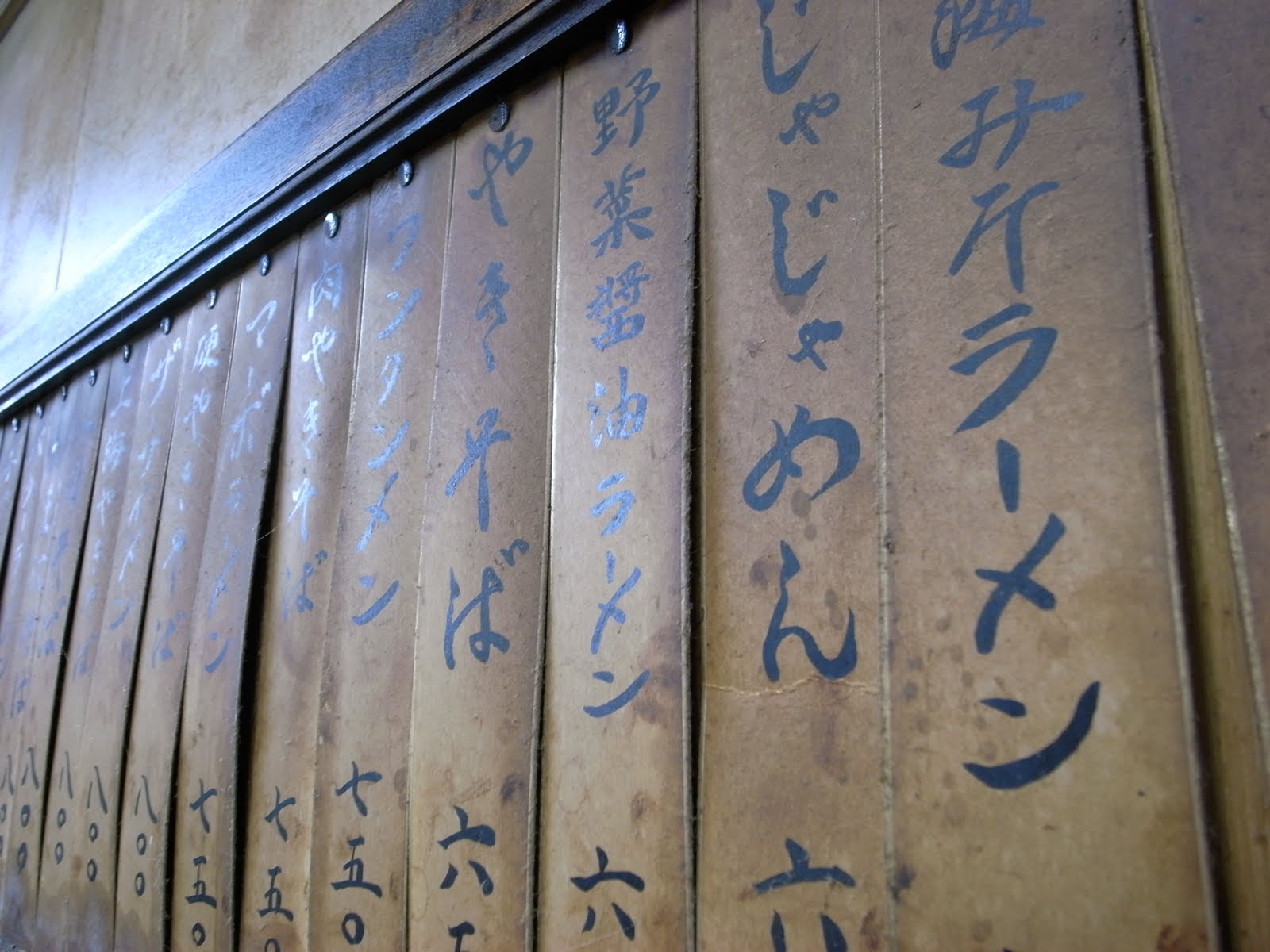
the worn-down old menu plates on the wall

I first went to "Mintei" when I was a teenager, which is a LONG time ago, and the place has not changed at all since. The only thing that has changed is probably the color of the several celebrity autographs on the walls, that have yellowed over the decades. One autograph that is worth mentioning is the one on top of the counter by the entrance, signed in 1989 by the vocalist from legendary punk rock band "The Blue Hearts", Hiroto Komoto.
Shimokitazawa being the THE indie/rock town of Japan, a lot of kids aspiring to be future stars, work part-time in some of the restaurants in the area before or after rehearsing at studios. Hiroto Komoto, one of them, used to work in Mintei in the 80s. The tradition is still holding strong, and if you ever visit this joint, you will probably see musician-looking-kids in the kitchen.
The customers are a mix of young couples, students, musicians, and middle-aged people from the neighborhood looking for a cheap meal.

the old autographs above the counter

Another thing worth noting is the rather "punk" catch-phrase outside the restaurant amusingly citing the joint as "serving the 3rd best food in the world". The reason why it's not the best or second best is, according to Mintei, because:
1. the best food in the world is the "Ofukuro No Aji", that is your mum's cooking (check out 2nd paragraph of this post for a little explanation)
2. the second best is your dad's shin taste when you bite on it (a Japanese expression saying "bite on your parent's shin" means to sponge off one's parents)
3, the third best food in the world is their Ramen

As you can see, one thing they do not lack is a good sense of humor. Now, is the food as good as the humor?

Well, I'd have to say it's not as great as what the joint's reputation would make you believe. I have never tried anything other than the "Edokko Ramen" (Edokko, literally kid from Edo, relates to a person born in Edo, the old Tokyo; such person is often perceived as being cheerful, in your face and straightforward), which consists of a big bowl of Shoyu Ramen with homemade Kimchi (Korean-style fermented cabbage with chili) on top and the "Wantan Men" (ramen with Chinese dumplings Won Ton), making it difficult to give you a constructive review of the place, but the house specialty "Edokko Ramen" is rather mediocre.

Edokko Ramen

The soup tastes like a lightly salted Torigara (chicken bones) and shoyu-based broth. It is relatively clear and not too oily. The soup tastes actually much better than the rest of the ingredients: the boiled Aona greens are very plain in taste and a bit too flabby, the large pieces of Chashu (Chinese style bbq pork) are fibrous and too low in salt.
The Kimchi is a little too strong in garlic for me, when I would have loved it slightly more sour and chilihot. It seems by the way quite unusual to name a Ramen "Edokko" when its particularity is the topped Korean item.
Last but not the least: the noodles, though ok in taste, are way lacking in Koshi, or firmness. I usually don't put much emphasis on the Koshi, but when the rest is average, you want at least your noodles to have some sort of character.

The Wantan Men's broth is on the other hand quite salty (even too salty I think), so only order it if you're ready for it.

As you can see, I'm not a big fan of their food. Once again, I've only tried a couple of Ramen dish, so that's not enough to give you a fair review, but so far, it's been mediocre. It will definitely give you an idea of what a lot of Ramen used to taste like all over Japan back in the good ol' days...

What's more interesting is definitely the Showa-era feel that the place resonates.


"Mintei" is closed on Mondays, and open the rest of the week from 11:30am to 23:20pm.
Setagaya-ku, Kitazawa 2-8-8
03-3466-7355
Click here for a MAP

City Country City (Cafe Restaurant), Shimokitazawa

I made a quick reference about "City Country City" in a previous post about the South Indian restaurant "Spice Kitchen Moona" as both joints hold business in the same building. Moona is on the 5th and "CCC" is one floor below.

This cafe/restaurant is owned and managed by Keiichi Sokabe, the leader of the 90s cult indie rock band "Sunny Day Service". The band broke up in 2000 and Keiichi has had a good solo career since, while simultaneously heading the label Rose Records and being a key figure in the indie scene.

His cafe is a hang-out place for his fans, indie kids roaming the streets of Shimokitazawa and people just wanting to chill out.
As per any musician-owned place, few signatures adorn the walls of the cafe (among which my very good buddy Alex From Tokyo's) as well as several hundred used vinyl records from Chicago House to indie Rock, which you can select from the racks and listen to before buying.

The place is overall very charming and clean, with a nice and relaxing feel. They do not blast the music, which is comforting, and a nice smell of incense floats in the air. I love the old upright piano by the window.

You can obviously go there for a cafe, but I went there for lunch the other day. The menu is very simple, with a set comprising of a limited choices of pasta, hot or cold coffee/jasmine tea or apple juice, all for little south of ¥1,000.

I chose the popular Spaghetti Carbonara (egg, grated cheese, bacon and black pepper). If you feel like it, have a quick look at the wiki article on this dish: it seems to be dating from the later half of the 20th century, making it a surprisingly very contemporary recipe. It is interesting to see that "It was first recorded after the war as a Roman dish, when many Italians were eating eggs and bacon supplied by troops from the United States".

The fettuccine used as pasti are quite firm, not to the al dente point though, and are good to chew on. The very delicately crispy bacon and the relatively thick sauce are well balanced in terms of saltiness and combine very well with the pasta.
it might be just a cafe, as well as a used record store, but they do know how to cook a good Carbonara. With a complimentary piece of quickly toasted sliced baguette bread (which I'm not sure is necessary with a plate of noodles), the whole meal cost me ¥950. Not too bad considering the nice service, the chill-out atmosphere and the taste of the food.

City Country City is open everyday from noon to 01:00am. Lunch is served from noon to 16:00pm
Setagaya-ku, Kitazawa 2-12-13, 4F
Click here for a MAP
03-3410-6080